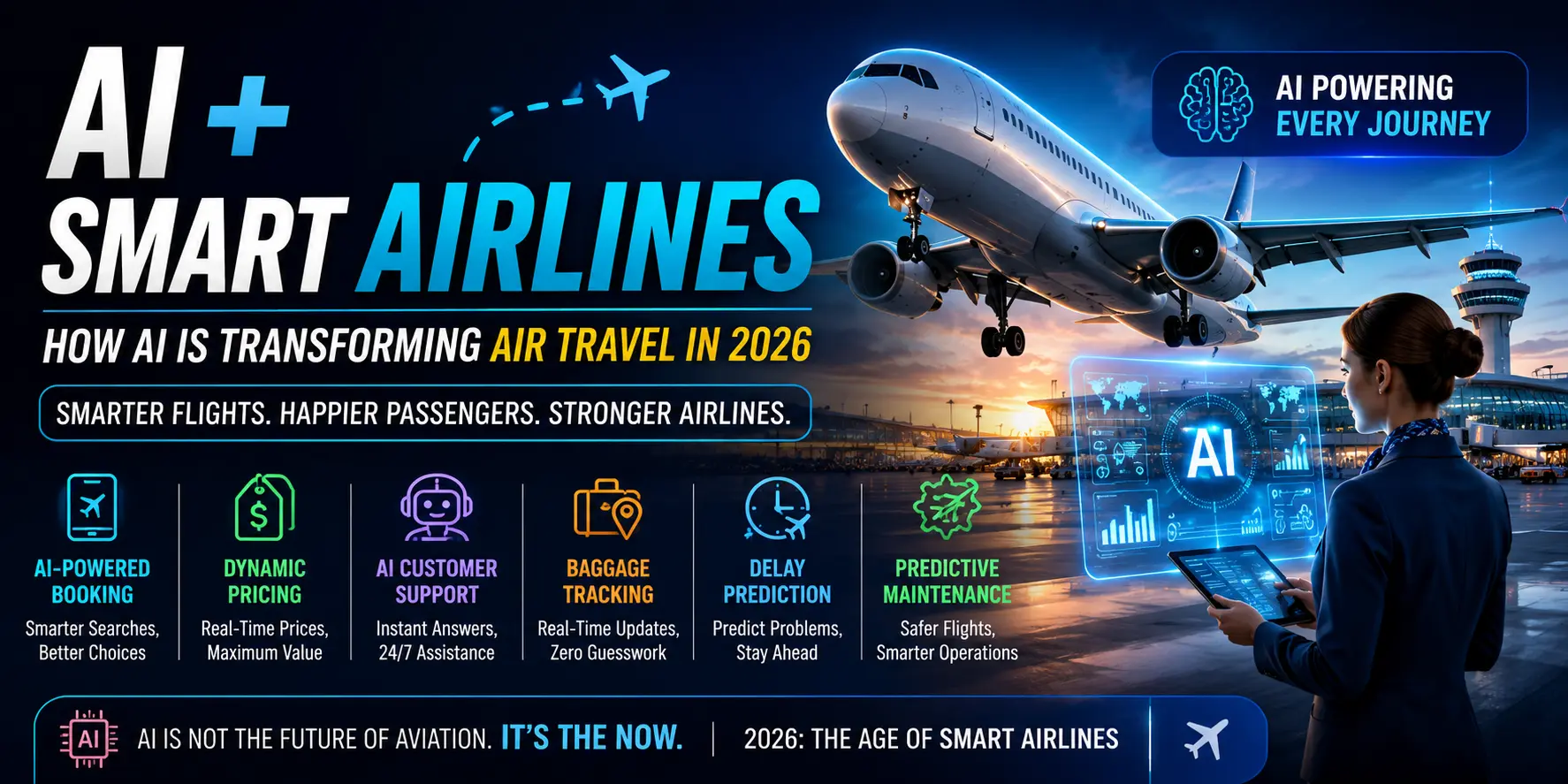
The airline industry is going through one of the biggest technology transformations in its history, and at the center of that transformation is artificial intelligence. In 2026, airlines are no longer using AI as an experimental technology or a side project. It has become a core part of daily airline operations. From the moment a passenger searches for a flight to the moment their baggage arrives at the destination, artificial intelligence is quietly working behind the scenes to make air travel faster, smarter, and more efficient.
For decades, airlines struggled with challenges like unpredictable delays, fluctuating ticket prices, overloaded customer support systems, baggage handling errors, and operational inefficiencies. These problems not only affected airline profitability but also damaged customer trust. Now, with the rise of AI-powered systems, airlines are beginning to solve many of these long-standing issues in ways that were almost impossible before.
This shift is not happening in one area alone. AI is now being used across booking systems, pricing engines, customer support, baggage tracking, airport operations, route optimization, and even aircraft maintenance. Industry analyses in 2026 show airlines and airports increasingly using predictive AI, computer vision, and automation to improve operations and passenger experience.
AI Is Making Flight Booking Smarter
One of the most visible changes passengers are experiencing is during flight booking. In the past, travelers had to manually compare prices, dates, stopovers, and seat options across multiple platforms. Today, AI-driven booking systems can understand traveler behavior, search history, budget preferences, and previous bookings to offer personalized flight recommendations.
If someone usually travels for business, AI systems can prioritize faster routes, premium seating options, and flexible tickets. If someone frequently travels with family, the system may recommend baggage-inclusive fares, convenient departure times, and child-friendly options.
This creates a booking experience that feels less like searching and more like receiving personalized travel suggestions. Travel technology providers in 2026 report that AI is increasingly being used to personalize booking flows and recommendations.
Dynamic Pricing Is Changing Airline Revenue
Airline pricing has always been complex, but AI has taken it to another level.
Traditional airline pricing relied on basic supply-and-demand calculations. Today, AI systems analyze thousands of real-time data points before adjusting ticket prices. These include:
Current seat demand
Seasonal travel patterns
Competitor pricing
Fuel prices
Airport traffic
Weather conditions
Local events and holidays
For example, if a major event is happening in a city, AI may predict increased demand even before passengers begin searching in large numbers. Airlines can then adjust prices automatically.
This allows airlines to maximize revenue while keeping occupancy rates high.
In many cases, passengers may not even realize that the price they see has been calculated by multiple machine learning models within seconds.
AI Customer Support Is Replacing Long Wait Times
One of the biggest frustrations for airline passengers has always been customer support.
Flight delays, baggage issues, cancellations, and refund requests often lead to thousands of passengers trying to contact support at the same time.
In 2026, airlines are increasingly solving this with AI-powered customer support systems.
Modern airline chatbots can now:
Answer baggage questions
Help with booking changes
Process refund requests
Share boarding information
Provide gate updates
Help with rebooking during disruptions
Unlike traditional support teams, these systems work 24/7 and can respond instantly in multiple languages.
Industry reports show airlines increasingly using AI-powered support systems to handle disruption spikes, baggage claims, and rebooking workflows more efficiently.
This not only improves passenger satisfaction but also reduces pressure on human support agents.
Baggage Tracking Is Becoming More Accurate
Lost baggage has always been one of the airline industry's biggest pain points.
In the past, passengers often had no idea where their luggage was once it disappeared.
That is changing rapidly.
Airports and airline operators are now using AI-powered baggage systems combined with computer vision, sensors, and predictive analytics.
These systems can:
Track baggage movement in real time
Detect routing mistakes before bags are misplaced
Predict baggage congestion
Automatically redirect luggage to correct paths
Some aviation systems in 2026 are using AI to monitor baggage flows dynamically and reduce operational errors.
For passengers, this means fewer lost bags, faster updates, and greater confidence during travel.
Delay Prediction Is Becoming More Accurate
Flight delays cost airlines billions every year.
In 2026, one of the most valuable applications of AI is predictive delay management.
AI models analyze huge amounts of operational data, including:
Weather forecasts
Air traffic congestion
Aircraft turnaround times
Crew availability
Historical delay patterns
Airport runway conditions
Based on this information, airlines can predict disruptions before they happen.
This gives operations teams time to:
Reassign gates
Adjust crew schedules
Notify passengers early
Prepare alternate routes
Airport technology reports in 2026 show AI-driven systems now proactively managing gates, delays, and staffing before bottlenecks happen.
Instead of reacting to problems, airlines are beginning to prevent them.
That is a major shift.
AI Is Improving Aircraft Maintenance
Passenger safety remains the highest priority in aviation.
AI is now helping airlines improve maintenance planning through predictive analytics.
Aircraft generate massive amounts of sensor data during flights.
AI systems analyze that data to detect patterns that may indicate future mechanical issues.
Instead of waiting for a part to fail, airlines can schedule maintenance before a breakdown occurs.
This improves:
Safety
Aircraft availability
Fuel efficiency
Operational reliability
Predictive maintenance is becoming one of the most valuable uses of AI in aviation because it reduces unexpected cancellations and technical disruptions. Airline technology analysts continue to highlight predictive maintenance as a major operational advantage.
The Passenger Experience Is Becoming More Personalized
Perhaps the biggest long-term impact of AI in aviation is personalization.
In 2026, airlines are using AI to understand passenger preferences at a much deeper level.
This includes:
Preferred meal choices
Favorite seat types
Frequent destinations
Upgrade behavior
Loyalty program usage
Travel patterns
AI can then personalize offers such as:
Seat upgrades
Lounge access
Hotel recommendations
Insurance offers
Loyalty rewards
Aviation industry surveys show growing passenger interest in personalized, digitally connected travel experiences supported by AI and biometric technologies.
This creates a travel experience that feels more premium and customer-focused.
The Future of Smart Airlines
The airline industry in 2026 is moving from manual operations to intelligent systems.
Airlines are no longer just transportation companies.
They are becoming data-driven technology platforms.
Artificial intelligence is helping them:
Improve profitability
Reduce delays
Increase customer satisfaction
Improve safety
Optimize operations
Build stronger passenger loyalty
The airlines that invest in AI today will likely lead the future of aviation tomorrow.
And for travelers, this means one thing:
Flying is becoming smarter than ever before.