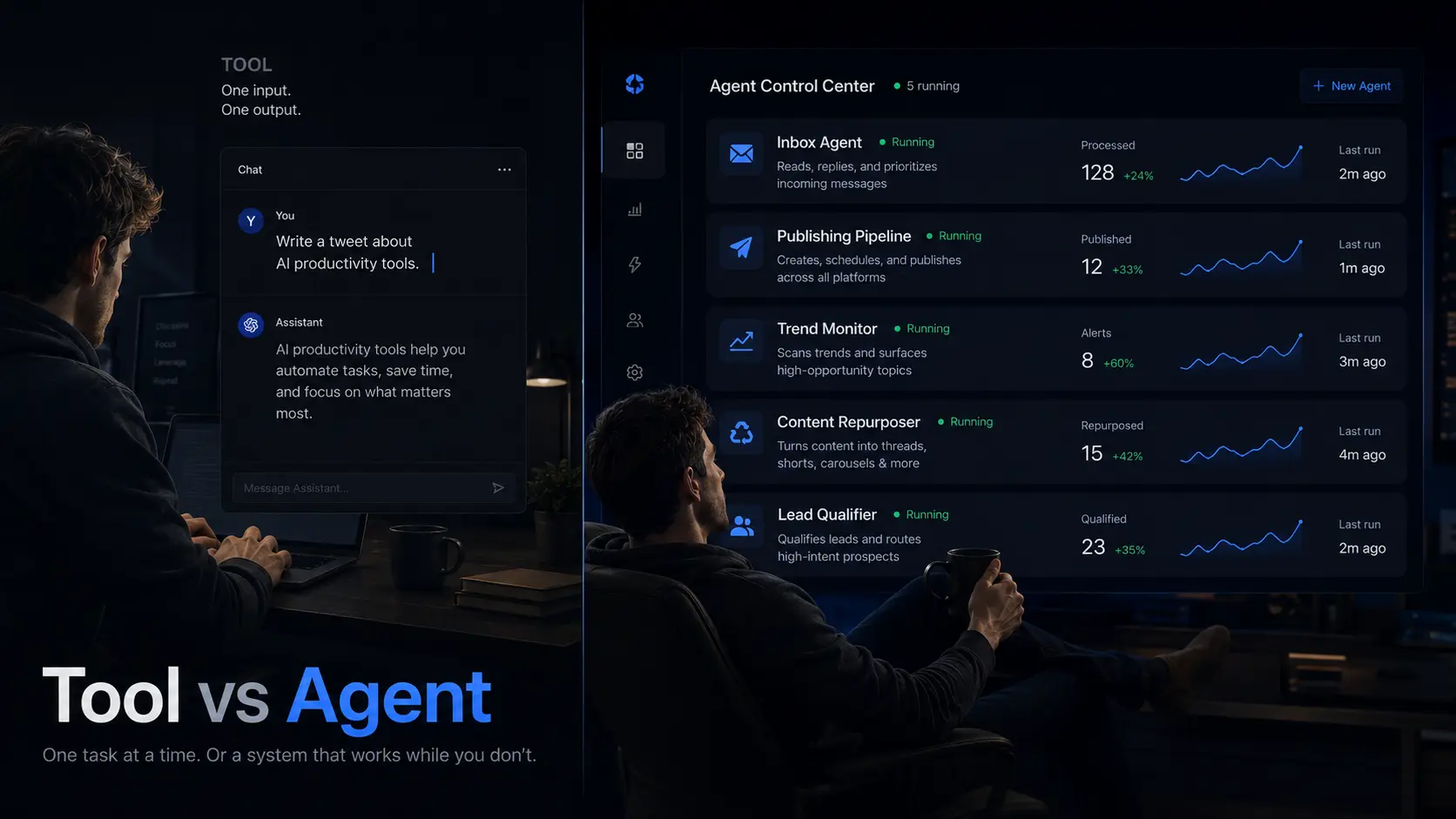
Most creators using AI in 2026 are making the same category error: they think they are building a workflow, but they are actually building a habit. Every time they open ChatGPT, type a prompt, read the output, and decide what to do with it — that is not automation. That is a manual task with an AI tool in the middle.
The distinction between an AI tool and an AI agent is not semantic. It is structural, and it determines whether your AI usage compounds or plateaus. According to Gartner, fewer than 5% of enterprise applications included task-specific AI agents a year ago. By the end of 2026, that number is projected to hit 40%. The shift from reactive tools to autonomous agents is underway — and creators who understand it early will have a meaningful operational advantage over those who do not.
The Core Difference: Reactive vs. Proactive
An AI tool waits. You open it, you give it a prompt, it responds, and then it stops. The next time you need something, you start again. ChatGPT, Claude, Midjourney, DALL-E — these are all tools. Brilliant, powerful tools, but tools nonetheless. They do not remember your last session in any meaningful way. They do not check on things while you sleep. They do not fire up because something happened in your business that they detected and acted on.
An AI agent runs. It operates against goals, not against prompts. You define what it should accomplish — monitor competitor pricing, process incoming client briefs, publish approved content to three platforms, alert you when a keyword spikes in search volume — and it executes, often without requiring your attention at each step. The trigger is not you typing. The trigger is a condition, a schedule, or an event in your environment.
AI tool: you ask, it answers. AI agent: you define a goal, it operates toward it continuously.
At a Glance: What Each Actually Does
AI Tool | AI Agent | |
Behaviour | Reactive — responds when prompted | Proactive — acts without being asked |
Trigger | You initiate every interaction | Runs on schedule, events, or conditions |
Memory | Forgets between sessions (mostly) | Maintains context across time |
Output | Text, image, code, audio | Completed tasks, filed documents, sent messages |
Oversight | You review every output | Operates autonomously; alerts on exceptions |
Best for | Creative generation, one-off tasks | Repeatable workflows, background operations |
Examples | ChatGPT, Midjourney, Claude, DALL-E | Lindy, Relevance AI, Zapier Agents, Copy.ai Workflows |
Why Creators Are Stuck on Tools
There is a reason most creators have not made the jump to agents yet: tools are intuitive and agents require architecture. Opening ChatGPT and typing is friction-free. Building a Lindy agent that monitors your inbox, classifies incoming brand enquiries, drafts personalised responses, and pings you only when it needs a decision — that requires an hour of setup, some logical thinking, and a willingness to test until the workflow runs cleanly.
The platforms are closing this gap aggressively. Zapier's AI Agent builder lets you describe a workflow in plain English and generates the automation logic. Lindy and Relevance AI offer pre-built agent templates for the most common creator workflows — content publishing, lead qualification, social monitoring, client onboarding. Copy.ai's Workflows tier, which starts free, allows creators to chain research, drafting, formatting, and publishing into a single pipeline that runs on a trigger rather than a command.
The result: the technical barrier to agents has dropped substantially. What required API knowledge and development time in 2023 now takes an hour of configuration in a no-code interface. The remaining barrier is conceptual — creators need to stop thinking in prompts and start thinking in processes.
The Numbers Behind the Shift
The data on what happens when creators and solopreneurs move beyond tools into agents is consistent enough to be instructive.
Solopreneurs implementing comprehensive AI automation — including agent-driven workflows — report saving 15 to 20 hours weekly on average, according to 2026 research tracking solo founder operations.
Human-AI collaborative teams using agent workflows demonstrate 60% greater productivity than human-only teams, while spending 23% more time on creative work and 60% less on editing, per research cited by Warmly.ai.
AI-assisted creators — those using automation workflows, not just generation tools — report a 58% increase in engagement rates over manual-only approaches, according to Content Marketing Institute's 2025 report. The differentiating variable: unique perspective layered on top of AI-generated drafts, not the generation itself.
83% of marketers say AI helps them produce significantly more content. But the gains are not evenly distributed — creators running agent-based workflows consistently outproduce those using tools alone at the same subscription cost.
Midjourney's operational efficiency — $500 million in 2025 revenue with 107 employees, roughly $4.7 million per employee — represents what systematised AI-first operations look like at the company level. For solo creators, the structural principle is the same: output scales without proportionally scaling human hours.
Building a Creator Stack That Uses Both
The practical answer in 2026 is not tools or agents — it is tools for generation and agents for operations. They serve different functions and the best creator workflows use both deliberately.
Use tools for:
Creative generation — writing first drafts, generating image variations, ideating formats, producing audio, building code
One-off decisions — research sessions, single-asset production, feedback on specific work
Craft refinement — editing, style adjustment, prompt iteration
Use agents for:
Content publishing pipelines — generate, format, schedule, and cross-post without manual steps per platform
Inbox and enquiry management — classify, draft responses, escalate to you only when human judgment is needed
Market and trend monitoring — surface relevant keywords, competitor moves, or audience signals on a schedule
Repurposing workflows — take long-form content and automatically generate clip selections, caption variations, and platform-adapted formats
The sequencing that works for most creators starting from zero: spend the first month optimising your tool usage — sharpen your prompt library, build templates, get consistent output quality from ChatGPT, Claude, or Midjourney. Then spend month two identifying the one workflow you repeat most often and building an agent around it. The return on that second month compounds every week the agent runs.
Where This Is Heading
The trajectory of AI agents is not gradual. Research tracking AI agent capability found that the range of tasks agents can complete autonomously with a 50% success rate has been doubling approximately every seven months. At that pace, tasks that currently require human oversight become agent-appropriate within a planning horizon that is relevant to any creator building a workflow today.
Capgemini Research Institute projects that by 2028, 38% of companies will treat AI agents as formal members of human teams. Adobe's 2026 Digital Trends report found that 69% of organisations expect agentic AI to handle research, insights, and knowledge retrieval tasks for their employees. The framing is shifting from 'AI as a tool you use' to 'AI as a team member with a role.'
For creators and solopreneurs, this shift means the operational model of the one-person studio continues to evolve. The most efficient creative businesses in 2028 will not be those with the most sophisticated prompts — though prompt quality will still matter for generation quality. They will be the ones where the gap between idea and published, distributed, tracked output is measured in minutes rather than hours, because agents handle the operational layer end-to-end.
The Takeaway
If you are using AI only as a tool — responding to prompts, one task at a time — you are using the less powerful half of what is currently available. The compounding gains come from agents: systems that operate toward goals, run without constant prompting, and handle the repetitive operational work that currently consumes your hours.
The place to start is not the most sophisticated agent platform. It is the most repetitive workflow in your current process. Find the thing you do manually three or four times a week, build an agent around it, and review the output. The generation quality of that agent will depend directly on the prompts it uses internally — which is where a solid, well-organised prompt library becomes infrastructure rather than a nice-to-have. Platforms like Prontly are built for exactly that: tested, production-ready prompts that give your tools and agents the right instructions from day one.