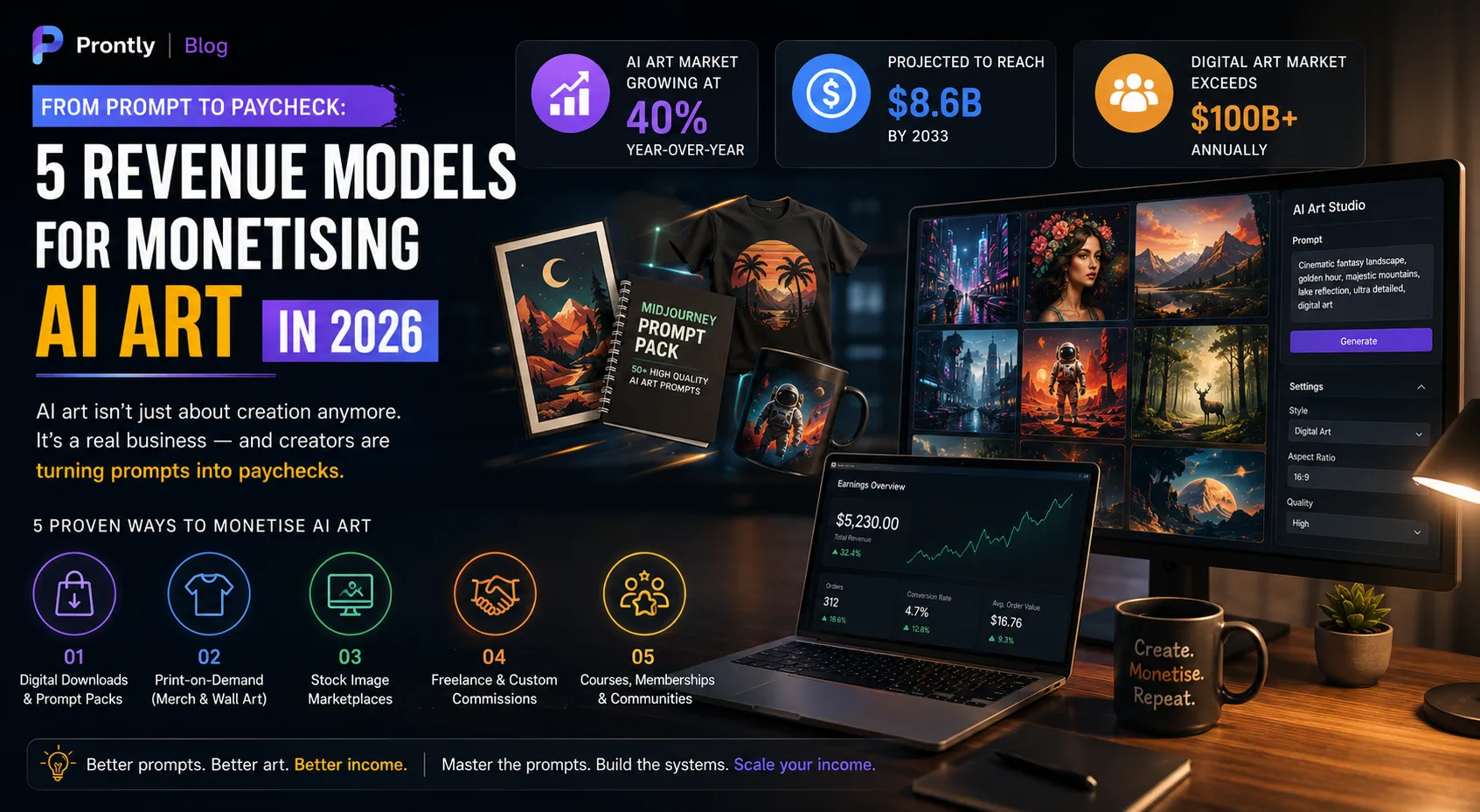
For most of AI art's short history, the conversation has centred on creation — which tool is best, how to write a better prompt, what style to chase. The monetisation question has lagged behind. That is changing fast.
The global market for digital art, custom graphics, and visual content now exceeds $100 billion annually. The AI art market specifically is growing at 40% year-over-year and is projected to reach $8.6 billion by 2033. Creators who combine genuine prompt skill with a deliberate revenue model are building five-figure monthly incomes — some without ever leaving their desks. Freelance AI artists are earning between $25 and $150 per project on platforms like Fiverr and Upwork. Stock image contributors with libraries of several hundred images report $50 to $500 per month in mostly passive income. Creators stacking multiple models are hitting five figures monthly.
This is not a get-rich-quick article. It is a map of what is actually working — the five revenue models with documented track records in 2026, their real income ranges, how long each takes to generate first income, and what separates the creators making meaningful money from those who try for two months and give up.
Before the Revenue Models: The Variable That Determines Everything
Every monetisation strategy for AI art shares the same rate-limiting factor: prompt quality. The platforms are accessible. The tools are cheap. The markets are established. What separates a creator whose Etsy store generates Rs 50,000 a month from one that generates nothing is almost always the visual output — and that is almost always a prompt problem, not a talent problem.
Stock libraries reject AI images that contain anatomical errors, watermark artefacts, or compositional inconsistencies. Print-on-demand designs that do not meet minimum resolution and visual quality standards fail to convert. Brand clients on Fiverr return to the creators whose first drafts require the fewest revisions. In every revenue model below, the practical ceiling is set by how reliably and quickly you can generate output that meets commercial quality standards. That skill — prompt engineering at a professional level — is the foundation. Everything else is distribution.
The 5 Revenue Models That Are Actually Working
Model 1 — Digital Downloads and Prompt Packs
💾 Digital Downloads & Prompt Packs
Income potential: $500–$3,000/month (scaling to $7,500+ with 50+ products) | Time to first income: 2–4 weeks to first sale | Difficulty: Beginner-friendly
Etsy and Gumroad are the dominant platforms. Zero inventory, automated delivery, fully passive once listed.
This is the lowest-barrier entry point and the fastest path to first income. You generate a collection of AI images in a coherent style or theme — minimalist wall art, retro travel posters, botanical illustrations, aesthetic phone wallpapers — package them as instant digital downloads, and list them on Etsy or Gumroad. Customers purchase and receive files immediately, with no involvement from you after the listing is live.
The maths are straightforward: a creator with 50 well-produced digital products earning an average of ten sales per month per product at $5 to $15 per download generates $2,500 to $7,500 monthly in passive income. The critical variable is niche specificity. Broad categories like 'landscape art' compete with hundreds of thousands of listings. Narrow niches — Art Deco travel posters for mid-century interior design enthusiasts, watercolour botanical prints for herbalists, dark academia aesthetic study room prints — have dramatically lower competition and higher conversion.
Prompt packs are an adjacent product with equally strong demand. An artist with a distinctive aesthetic can curate and sell the exact prompts behind their best work as a downloadable guide. Gumroad and Ko-fi are the natural homes for this format. The most successful prompt packs in 2026 are not random collections of tips — they are tightly themed, heavily tested libraries organised by use case and style, with before-and-after image examples. This is also, incidentally, where platforms like Prontly function as a public-facing proof of concept: a curated, searchable prompt library demonstrates to potential buyers what a well-organised collection actually looks like.
Model 2 — Print-on-Demand
🖨️ Print-on-Demand (Merch & Wall Art)
Income potential: $300–$2,000/month; higher in proven niches | Time to first income: 3–6 weeks (product setup + early sales cycle) | Difficulty: Beginner to intermediate
Printful, Redbubble, Amazon Merch. Zero inventory, global fulfilment. Niche selection is everything.
Print-on-demand takes AI-generated images and places them on physical products — apparel, posters, phone cases, tote bags, mugs, cushions — without requiring any inventory, upfront investment, or fulfilment management. Printful, Redbubble, and Amazon Merch handle production and shipping. Your job is design and positioning.
The model works best when the niche is specific enough to attract a dedicated buyer but large enough to sustain volume. Retro-futurist space art on apparel. Minimalist nature prints for Scandinavian-style interiors. Cottagecore mushroom illustrations for the aesthetic home decor market. Vague, category-level designs compete on price and lose. Niche designs compete on resonance and win. Midjourney V8's native 2K output has made the resolution barrier for print effectively a non-issue for most product types — a significant change from two years ago when upscaling was a standard additional step.
The most common mistake is treating print-on-demand as a passive income machine from day one. It is not. The first two to three months require consistent uploading, keyword research, and iteration on what sells. Once a handful of designs demonstrate organic traction, paid promotion and doubling down on proven styles accelerates from there.
Model 3 — Stock Image Licensing
📸 Stock Image Licensing
Income potential: $50–$500/month per library of 200–500 images; scales with volume | Time to first income: 4–8 weeks (submission review + initial downloads) | Difficulty: Intermediate — quality standards are strict
Adobe Stock, Shutterstock, Depositphotos. Requires disclosure of AI origin. Commercial-use images outperform artistic ones.
Major stock platforms including Adobe Stock, Shutterstock, and Depositphotos now accept AI-generated content with disclosure requirements. The opportunity is real, but the misunderstanding is also real: the stock images that sell are not the visually impressive ones. They are the commercially practical ones.
Businesses buying stock images are looking for professional-looking people in workplace settings, clean product photography backgrounds, abstract business concept illustrations, diverse lifestyle imagery, and seasonal content with broad application. The AI art that looks most impressive on Instagram — surreal landscapes, fantastical creatures, dramatic concept art — is the stock art that sells the least. Generators who understand this distinction and produce specifically for commercial buyer intent consistently outperform those uploading their personal portfolio favourites.
Quality standards are non-negotiable. Anatomical errors, unnatural hands, visual artefacts, and watermark residue are common rejection reasons for AI-generated submissions. A library of 300 to 500 high-quality, commercially oriented images is the realistic baseline for generating consistent monthly passive income from this model.
Model 4 — Freelance Visual Services
💼 Freelance AI Visual Services
Income potential: $25–$150 per project; $2,000–$8,000/month for established freelancers | Time to first income: 1–3 weeks (first client; faster with portfolio) | Difficulty: Intermediate — positioning and client management matter
Fiverr, Upwork, 99designs. Position as a creative problem-solver, not a tool operator.
Freelance AI art is a service business, not a product business. Clients — brands, content creators, authors, app developers, marketing agencies — hire you to generate specific visuals for their needs: social media graphics, blog illustrations, book covers, album art, product concept mockups, ad creatives. The platforms connecting buyers to AI artists include Fiverr, Upwork, and 99designs.
The positioning insight that separates six-figure freelancers from those who struggle to find clients: market yourself as a creative director who uses AI, not as someone who uses AI to make art. The distinction is commercial. Clients do not want someone who will 'put their brief into Midjourney.' They want someone who will interpret a brand brief, generate multiple direction options, refine based on feedback, and deliver production-ready files. That workflow requires taste, communication skills, and prompt mastery — none of which are automated.
Portfolio is the single biggest accelerant. A Fiverr or Upwork profile with ten to fifteen polished examples across diverse styles — and explicit evidence of the use cases you serve (brand campaigns, editorial illustrations, social content, book covers) — converts significantly better than a generic gallery. Build the portfolio first, even for free if necessary, then price for the value of the output rather than the time it takes to generate.
Model 5 — Platform Monetisation and Creator Programs
📱 Platform Creator Programs
Income potential: Variable; engagement-dependent; best as a supplementary stream | Time to first income: 2–6 weeks from sign-up to first payout | Difficulty: Beginner — accessible with no follower minimum on newer programs
Picsart's open monetisation program (launched April 2026), Patreon, Ko-fi, YouTube. Rewards engagement quality over audience scale.
April 2026 brought a significant development for AI creators: Picsart, with over 150 million monthly users, launched an open creator monetisation program with no invite list and no minimum follower requirements. Creators earn based on engagement metrics — views, comments, shares, and reach — by producing original content with Picsart's AI tools for specific campaigns. Payouts are managed through Stripe.
This model signals a broader shift in the creator economy: platforms are moving from scale-based monetisation (you need 10,000 followers to qualify) to quality-based monetisation (your content's engagement determines your earnings). For AI creators building an audience around their work, this represents the most accessible entry into platform revenue that has ever existed.
Subscription platforms like Patreon and Ko-fi work particularly well for creators with a distinctive, recognisable aesthetic. Members pay a monthly fee for access to exclusive prompt packs, high-resolution downloads, early access to new collections, or tutorials on the creative process. The value proposition is the eye and the taste behind the work — the curation — not just the output itself.
How to Stack the Models (And When)
The creators earning the most from AI art in 2026 are almost never dependent on a single revenue stream. The practical stacking sequence that works for most creators starting from zero:
Start with digital downloads on Etsy or Gumroad. Lowest friction, fastest path to first income, zero upfront cost. This forces you to develop a coherent aesthetic and understand what buyers actually want.
Add print-on-demand with your best-performing designs. Designs that sell as digital downloads are validated market signals — convert the top performers to physical products on Printful or Redbubble.
Open a Fiverr or Upwork profile once you have ten to fifteen portfolio pieces. Use the proven aesthetic from your Etsy work as the visual foundation. Start at competitive pricing, collect five-star reviews, raise rates as demand builds.
Add stock licensing as a passive layer once you understand commercial image requirements. Repurpose the prompt knowledge from your freelance work to generate commercially viable stock imagery systematically.
Explore platform programs and subscription models at six to twelve months, once you have an audience and consistent output. Patreon and Ko-fi work when people already know your work. Do not start here.
The Legal Layer You Cannot Ignore
The copyright landscape around AI-generated images is still actively evolving in 2026 — and the specific rights you have vary significantly by tool, plan, and jurisdiction.
Midjourney: Paid plan subscribers have commercial usage rights. Free tier users do not. Check the current Terms of Service before selling any work generated on a free account.
DALL-E / OpenAI: Commercial use is permitted for ChatGPT Plus subscribers. Full API access includes commercial rights.
Stable Diffusion: Open-source base models are generally permissive, but check the licence terms for each community model individually — some restrict commercial use.
Stock platforms: Adobe Stock, Shutterstock, and Depositphotos now require explicit disclosure that images are AI-generated at the point of upload. Non-disclosure is a terms violation and can result in account suspension.
India IT Rules 2026: New synthetic content disclosure requirements apply to creators distributing AI-generated content at scale. If your operation grows beyond personal use, legal compliance is worth reviewing with a professional.
Transparency is increasingly a brand asset rather than a liability. Many successful AI artists in 2026 actively promote the AI component of their work, positioning it as technological craft rather than something to obscure.
The lesson
The money in AI art is real, documented, and accessible at multiple entry points. What it is not is automatic. The creators building consistent income from this space treat it as a business: they understand their market, develop a recognisable aesthetic, systematise their production, and stack revenue models deliberately rather than randomly.
Every model above rewards the same underlying skill: the ability to generate high-quality, commercially relevant images reliably and efficiently. That skill starts with knowing how to write a prompt that works — and compounds into everything from a passive Etsy income to a full-time freelance studio. Platforms like Prontly exist to give creators the prompt foundation to get there faster: a curated library of production-ready prompts, organised by style and use case, built for the tools you are already using. The business model is yours to choose. The prompt infrastructure is the place to start.