A graphic designer in Bhopal. A cooking creator in Coimbatore. A finance educator posting from a one-bedroom flat in Lucknow. All three have built audiences in the tens of thousands. All three are producing content that people actively watch and share. And statistically, there is a very high chance that none of them is earning a livable income from it.
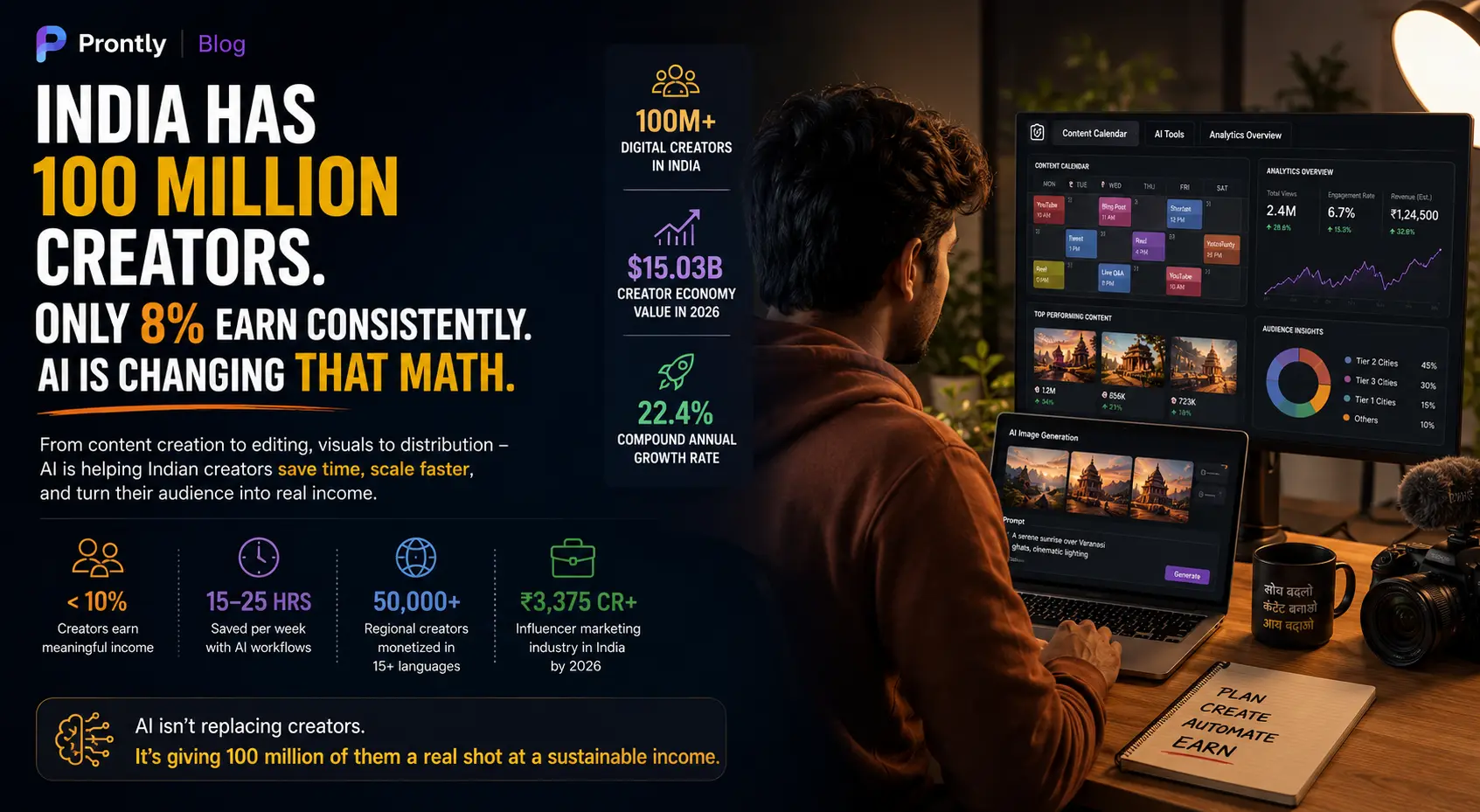
India has crossed 100 million digital creators. The country's creator economy is valued at $15.03 billion in 2026 and is growing at a 22.4% compound annual rate — one of the fastest in the world. And yet fewer than 8 to 10% of those creators earn meaningful, consistent income from their work. The gap between audience size and revenue is not a content quality problem. It is a systems problem. And in 2026, AI is the most powerful lever available to close it.
The Scale of the Opportunity — and the Gap
The numbers paint a picture of extraordinary opportunity alongside extraordinary inefficiency. India has crossed 900 million internet users. YouTube India reports that over 60% of its watch time now comes from regional language videos — Tamil, Telugu, Bhojpuri, Marathi — created by people outside the four metros. ShareChat's Moj platform alone gave 50,000 regional creators a monetisation pathway across 15 Indian languages in 2024. Oxford Economics calculated that India's creator ecosystem contributed over Rs 16,000 crore to the country's GDP in 2024 and supported more than 930,000 full-time equivalent jobs.
8–10%
the share of India's 100M+ creators who earn meaningful income from their content (Coherent Market Insights, 2026)The concentration problem is severe. The top 1% of Indian creators capture over 80% of total platform revenue. The median creator with 10,000 to 50,000 followers earns between Rs 5,000 and Rs 15,000 a month — a supplementary income at best. The audience is there. The engagement is real. What is missing, for the overwhelming majority, is the production infrastructure and content velocity needed to convert reach into revenue.
Why the Monetisation Gap Exists
The structural reasons for India's creator monetisation gap are worth understanding precisely, because AI addresses several of them directly and simultaneously.
Production bottlenecks
The most common reason creators plateau is not lack of ideas — it is lack of production capacity. Creating one quality video, editing it, designing the thumbnail, writing the caption, repurposing it across Instagram, YouTube Shorts, and LinkedIn, and scheduling distribution is a multi-hour process per piece of content. A Kofluence survey of over 2 million Indian creators found that 59% regularly use AI tools, with content ideation leading at 64.4%. But the majority are using AI for brainstorming, not for the production workflows that actually save time. Creators using AI across the full production stack — from visual generation to repurposing to scheduling — report saving 15 to 25 hours per week. That time compounds directly into more content, more algorithm exposure, and faster audience growth.
The regional language gap in AI tools
Until recently, most AI content tools were English-first. For a creator in Patna producing Hindi content or a YouTuber in Madurai making Tamil videos, the practical benefits of AI were significantly narrower. That is shifting fast. Multi-language audio tools, real-time auto-dubbing, and regional language AI assistants are removing the language barrier at the production level. YouTube's native AI Playground within Shorts is being built with Indian language creators as a primary use case. For Tier 2 and Tier 3 creators — the segment with the most undermonetised audiences — this is the first time AI tooling is genuinely accessible in their language and format.
Visual content quality as a monetisation signal
Brands allocating influencer marketing budgets — projected to exceed Rs 3,375 crore in India by 2026 per Ernst and Young — are increasingly using content quality as a primary filter. A creator with 40,000 followers and consistently polished visual content is more likely to land a brand deal than one with 80,000 followers and mediocre graphics. AI image generation and visual prompt libraries are quietly becoming a competitive advantage for mid-tier Indian creators who cannot afford a dedicated designer but need brand-quality visuals to attract brand-quality partnerships.
What the Winning 8% Are Actually Doing Differently
The creators earning consistently in India share a pattern that has nothing to do with follower count and everything to do with systems. The Kofluence 2026 Decoding Influence report found that 15.2% of active Indian creators are now registered as a business entity or GST individual — a figure that represents the new minimum threshold for institutional brand partnerships. The formalisation of content creation as a business has arrived.
Within that formalised group, the approach to content production looks markedly different from the average creator. Rather than treating each piece of content as a standalone effort, they treat their creative operation as a machine: one idea generates five formats, each format is produced in a fraction of the time through AI assistance, and every output is tracked against performance data that informs the next cycle. Creators using this approach produce three to five times more content at similar or better quality than those working manually.
The visual layer is particularly important for brand monetisation. A creator in the Nano tier (1,000 to 10,000 followers) — which represents 61.1% of all Indian creators — competing for brand attention needs to signal professionalism through production quality before follower count makes the argument for them. AI-generated visual assets, when built from high-quality prompts, close that gap at near-zero cost.
Four Places to Start Building Your AI Content System
For Indian creators looking to move from the 92% to the 8%, these four areas return the most value per hour invested:
Visual content production: Stop starting from scratch for every thumbnail, post graphic, and carousel. Build a library of tested AI image prompts tuned to your aesthetic — or use a curated one — and generate campaign-quality visuals in minutes rather than hours. Tools like Midjourney and DALL-E 3 are accessible on budgets that make sense for Indian creators; the skill is in the prompt, not the subscription tier.
Content repurposing automation: Every long-form video or article you produce should automatically feed at least five pieces of short-form content. OpusClip, with its one-click repurposing from long-form to Shorts and Reels, reports 80% time savings within the first month of use. That is 10 to 15 hours a week redirected to strategy, brand outreach, or building a second content vertical.
Regional language AI workflows: If you create in Hindi, Tamil, Telugu, Bengali, or any other Indian language, explore tools now supporting regional language generation. ElevenLabs offers voice synthesis with natural Indian accent options. AI writing assistants with multilingual capability are closing the Hindi-English gap fast. Creators who build in their native language with professional-grade production will have a significant first-mover advantage in regional monetisation.
Performance-informed prompt libraries: The creators growing fastest in 2026 are the ones who treat their best-performing content as a template, not a fluke. When a visual or format works, document what made it work — the prompt, the composition, the style — and systematise it. A growing prompt library is a compounding asset; every refined prompt shortens your next production cycle.
Where India's Creator Economy Is Heading
The India creator economy market is forecast to reach $61.87 billion by 2033. Direct creator revenues are projected to grow fivefold by the end of the decade. Asia Pacific — with India at its centre — is the fastest-growing creator economy region globally, overtaking North America's market share by the mid-2030s.
The near-term shift is from individual creators to creator-led businesses. India's new IT Rules 2026 introduce synthetic content disclosure requirements that will push professional creators toward documented, verifiable AI workflows. The GST-registered creator is the new baseline for brand partnerships. Agentic AI — tools that autonomously draft content calendars, generate visual assets, and queue publishing without manual triggers — will compress production timelines further. The creators who build AI-powered systems now will be positioned to operate at a scale that simply was not achievable for a one or two-person operation three years ago.
The Takeaway
India's creator monetisation gap is real, persistent, and structural. It is not solved by posting more or chasing trends harder. It is solved by building systems that make professional-quality production repeatable and fast — regardless of whether you are creating from Mumbai or Meerut, in English or in Maithili.
AI is the most accessible infrastructure for that system that has ever existed. Platforms like Prontly are built to give creators a running start on the visual production layer — a curated library of production-ready AI image prompts that compress the time between idea and professional output. The 8% who earn consistently are not more talented than the 92%. They have better systems. Building those systems is now a practical, affordable choice for any creator in India willing to make it.