A freelance illustrator recently told me she'd spent three months paying for both Midjourney and ChatGPT Plus, generating images on both platforms, and still feeling vaguely uncertain about which one she should actually be using. She wasn't alone. With at least six production-grade AI image generators now on the market — and a new model launching every few months — most creators are picking tools based on what they see trending on Twitter rather than what actually fits their work.
The AI image generation market is now worth $12.4 billion in 2026. Midjourney V8 launched in March with a fully rebuilt engine producing native 2K output. OpenAI retired DALL-E 3 and replaced it with GPT Image 2 in April. Flux 2 from Black Forest Labs rewrote the economics of open-source generation. The tools have genuinely never been better — and the choice between them has never mattered more. Here is an honest breakdown of what each platform is actually for.
Why the Tool You Pick Changes Everything
This is not a situation where any AI image generator will do and you just pick whichever one looks best in a YouTube thumbnail. The three major platforms approach image generation from fundamentally different design philosophies, and choosing wrong costs real money and workflow hours.
Marketing teams at Fortune 500 companies have made this mistake at scale — paying $30 a month for Midjourney subscriptions when their primary use case was generating images with legible text (a task where DALL-E is dramatically stronger). Design agencies have used ChatGPT-integrated image generation for brand campaign work without understanding the commercial licensing implications. A Rotterdam creative bureau switched to Stable Diffusion, trained a custom model on their brand guidelines, and now produces 500 mockups a month for e-commerce clients at near-zero cost. The same move would be completely impractical for a solo creator without technical knowledge.
The model landscape in 2026 has split into three distinct tiers: proprietary quality leaders like Midjourney V8 and Flux Pro, accessible generalists like DALL-E and Adobe Firefly, and open-weight community tools like Stable Diffusion and Flux Schnell. Understanding which tier serves your work is the first decision — tool selection comes second.
The Case for Each Tool
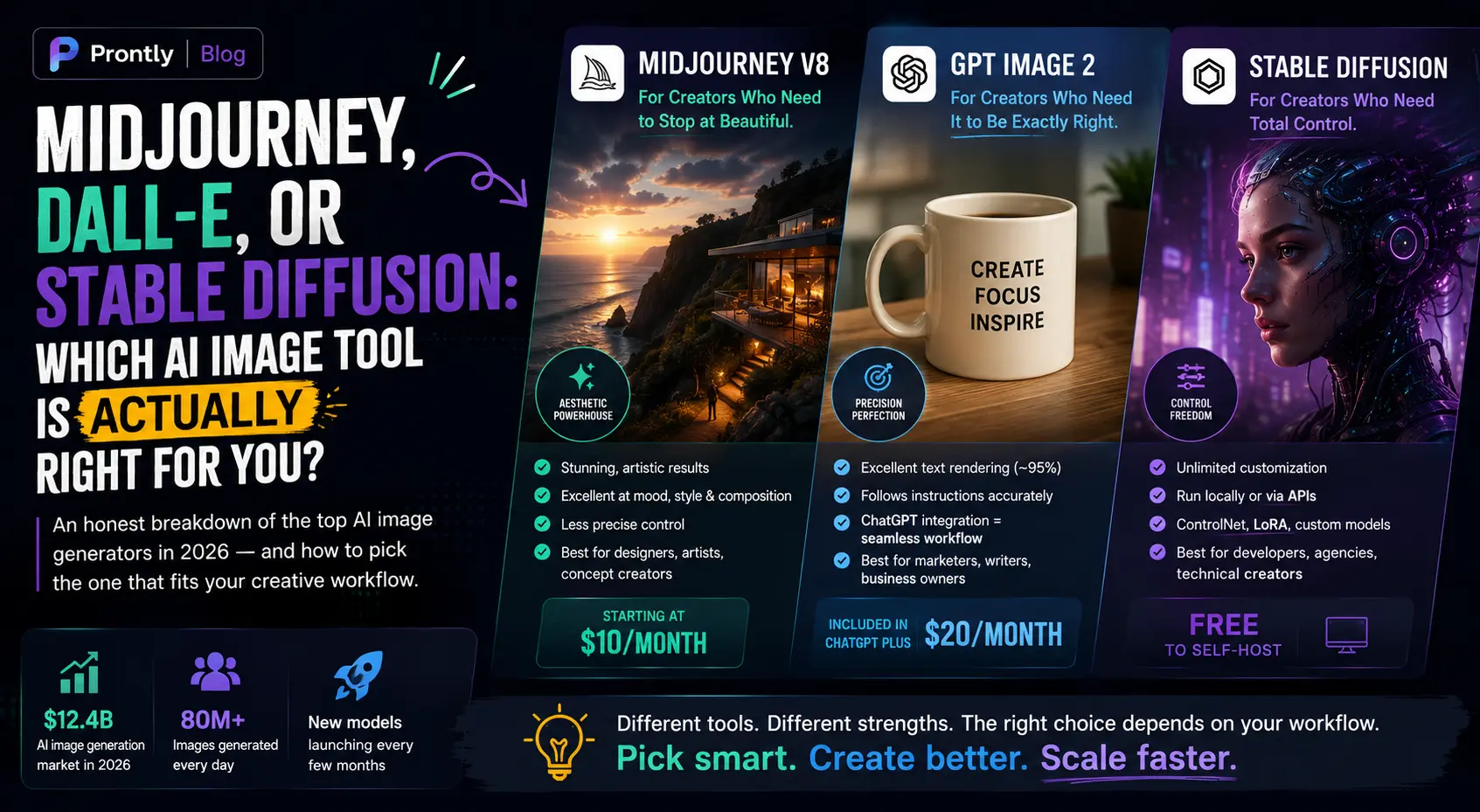
Midjourney V8 — For Creators Who Need to Stop at Beautiful
Midjourney remains the aesthetic benchmark. Its V8 engine — five times faster than V7 with native 2K output — produces images that look like they were shot or painted by a professional. The platform's particular strength is what might be called aesthetic intelligence: the way it interprets mood, composition, and style from an imprecise prompt and turns it into something that genuinely looks crafted.
The trade-off is control. Midjourney will consistently give you something stunning. It will not always give you exactly what you described. If your work demands precise prompt adherence — specific object placement, exact text within images, complex multi-element scenes — Midjourney will frustrate you. The Discord-and-web-app interface also has a learning curve that DALL-E simply does not have. Best for: designers, art directors, brand content teams, concept artists, editorial creators. Starting at $10/month.
GPT Image 2 (formerly DALL-E) — For Creators Who Need It to Be Exactly Right
OpenAI's April 2026 release of GPT Image 2 added a reasoning step to image generation — a meaningful architectural change that made it noticeably better at multi-element scenes, complex instruction following, and text rendering. In benchmarks, it achieves approximately 95% accuracy on legible text inside images, a task where Midjourney still struggles.
Because it runs inside ChatGPT, the workflow is conversational. You describe what you want, see the result, say 'make it warmer' or 'add a coffee cup to the left foreground,' and iterate without rewriting your prompt from scratch. For bloggers, marketers, and content creators who need reliable, accurate output and are already paying for ChatGPT Plus, this is the path of least resistance. Best for: writers, marketers, social media managers, small business owners, anyone who needs readable text in images. Included in ChatGPT Plus at $20/month.
Stable Diffusion — For Creators Who Need Total Control
Stable Diffusion is not a tool — it is infrastructure. Running locally on your own hardware or through APIs on platforms like Civitai, it produces unlimited images at near-zero cost and allows customization that no commercial tool approaches. ControlNet lets you specify exact image composition. LoRA training lets you fine-tune the model on your own visual style, brand assets, or character designs. The open-source ecosystem means thousands of community-developed specialized models exist for nearly every visual category imaginable.
The barrier is real. Most serious Stable Diffusion users in 2026 have actually migrated to Flux, the open-weight model from Black Forest Labs that matches Midjourney-class quality at a fraction of the API cost. But both require meaningful technical setup. Best for: developers, technical creators, agencies running high-volume pipelines, anyone requiring custom model training. Free to self-host.
Quick Comparison at a Glance
Midjourney V8 | DALL-E / GPT Image 2 | Stable Diffusion | |
Best for | Artistic quality | Prompt accuracy | Control & custom models |
Price | $10–$60/month | $20/mo (ChatGPT Plus) | Free (self-hosted) |
Ease of use | ★★★★☆ | ★★★★★ | ★★☆☆☆ |
Text in images | Improving (V8) | ~95% accuracy | Moderate |
Commercial use | Paid plans | Yes (ChatGPT Plus) | Check model terms |
API access | Limited | Full OpenAI API | Full (open source) |
How to Actually Choose
The most pragmatic decision framework in 2026 cuts through the noise quickly. Answer these three questions:
Does your work require text in images? If yes — posters, social graphics, signage, logos — go to DALL-E / GPT Image 2 first. Nothing else is close on text accuracy.
Do you need maximum aesthetic quality with minimal prompting effort? Midjourney. The quality-to-effort ratio is still unmatched at $10 to $30 a month.
Do you generate at volume, need custom model training, or require commercial licensing certainty? Stable Diffusion / Flux for volume and control. Adobe Firefly for legally risk-free commercial assets.
Many professional creators run a multi-tool workflow rather than picking one exclusively: Midjourney for initial concept generation and campaign imagery, DALL-E for any asset requiring readable text, and Stable Diffusion or Flux for high-volume production work. This is not overthinking — it is how creative agencies are actually structured in 2026.
One thing holds across every tool: the prompt is the variable that matters most. Identical prompts produce dramatically different results on different days and with different phrasing. Investing in a library of tested, refined prompts — organized by tool, style, and use case — compounds over time in a way that switching platforms every quarter never will.
Where the Field Is Heading
The pace of change in AI image generation makes any specific tool recommendation a 12-month statement at best. Flux 2 fundamentally changed the cost economics of quality generation when it launched in November 2025. Google's Imagen 4, released in April 2026, matched or surpassed GPT Image 2 on photorealism benchmarks. Midjourney's V8 engine closed the speed gap that had always been its most practical weakness.
The direction is clear even when the specifics are not: these tools are converging on quality while diverging on use case. By 2028, the technical differences between the leading platforms will matter less than the ecosystem, licensing structure, and workflow integrations built around each. Creators who understand which tool serves which job today will be well-positioned to adapt as the landscape continues to shift.
The Bottom Line
Stop trying to find the single best AI image generator and start figuring out which tool is right for your specific use case. For most visual creators, Midjourney is the place to start. For marketers and content teams, GPT Image 2 inside ChatGPT is the practical workhorse. For technical creators building at volume, Flux and Stable Diffusion are worth the setup investment.
Whatever tool you land on, the throughline is the same: the quality of your output is a function of the quality of your prompts. Platforms like Prontly exist to give creators a curated, searchable library of production-ready prompts — matched to the tools they're actually using — so the time goes into creating, not into figuring out how to talk to the machine.