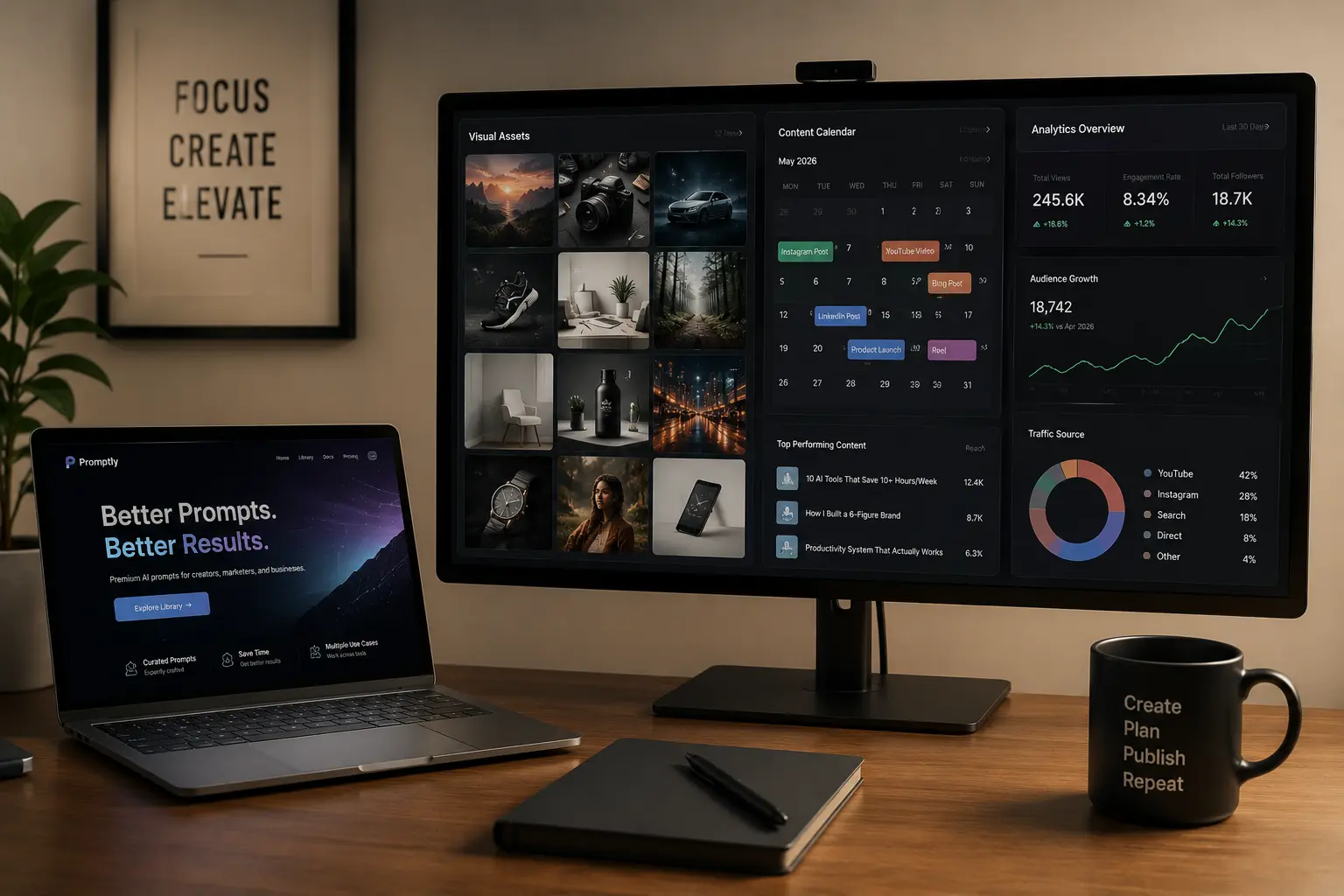
Three years ago, a one-person creative studio meant bottlenecks everywhere: one set of hands for client work, one brain for strategy, and a constant backlog of things that would get done whenever they got done. In 2026, that model is being quietly dismantled. Not by hiring — by automation.
The numbers are hard to argue with. There are now 41.8 million solopreneurs in the United States alone, contributing $1.3 trillion to the economy. Solo-founded startups have jumped from 23.7% of all new ventures in 2019 to 36.3% by mid-2025. And in a September 2025 survey of 6,500 creators conducted by Artlist, 87% reported using AI in their creative workflows — with more than 40% using it daily. The one-person creative business is not a stepping stone anymore. For a growing number of people, it is the destination.
Why This Is Happening Now, Not Earlier
The conversation about AI replacing workers has been running for a decade. What actually happened in 2024 and 2025 was more interesting: AI stopped threatening creative work and started enabling it. The shift was not in the technology alone — it was in the cost structure.
AI automation has slashed operating costs for solo operators by as much as 98% on specific production tasks, according to analysis cited by entrepreneur communities tracking the solopreneur market. A full creative content stack that would have required a three-person team in 2022 — copywriting, graphic design, video editing, social scheduling — now runs on a combination of AI tools costing less than $150 per month. Brands using AI-driven workflows are reporting a 67% reduction in content production costs compared to fully manual campaigns, per Forrester Research's 2026 State of Marketing Automation report. For a solo creator or a freelance studio, that compression changes the entire economics of staying competitive.
The result: 94% of solopreneurs now project business growth in 2026 — a record high, according to OnDeck's annual survey. This is not optimism without evidence. It is confidence backed by real leverage.
What the AI-Powered Creative Stack Actually Looks Like
Ask a high-earning solopreneur creative what their workflow looks like in 2026 and you will not get one tool — you will get a layered system where AI handles production while the human handles direction and taste. The stack typically covers four areas:
Content & Copy
Large language models have moved well past drafting blog posts. Creators are using AI to generate variations for A/B testing, adapt content for different audiences and platforms, and maintain a consistent brand voice across every output. The workflow that works: generate five variations of anything rather than chasing one perfect draft, then edit the best elements together. It is faster than writing from zero and produces output that would otherwise require a full editorial team to iterate at speed.
Visual Production
AI-generated images now account for 79% of all visual content posted on major platforms including Instagram, TikTok, and Pinterest, according to a Reuters Digital Media Report from early 2026. That figure would have been unthinkable four years ago. The solo creator who once waited days for a designer to turn around visual assets now generates an entire campaign's image library in an afternoon — provided they know how to write a prompt. This is precisely where a well-organized prompt library pays dividends: the difference between spending three hours generating mediocre outputs and thirty minutes generating campaign-ready visuals is almost always a better prompt, not a better tool.
Video & Audio
Tools like OpusClip have made one of the most time-consuming creative tasks — repurposing long-form video into platform-specific short clips — largely automated. Users report 80% or greater time savings on video repurposing within their first month of consistent use. AI voice tools from ElevenLabs produce narration indistinguishable from professional voiceover at a fraction of the cost. Combined, these tools mean that a solo creator with a once-weekly podcast or YouTube video now has a week's worth of short-form content without a single additional hour of editing.
Distribution & Analytics
Social scheduling, performance analysis, A/B testing, and audience segmentation have all matured into AI-assisted or fully automated functions. A creator who was previously spending eight hours a week managing posting schedules across platforms can now automate the mechanics and redirect that time toward work that actually requires a human.
The Practical Reality: What a Top-Earning Solo Creator Actually Does Differently
The 20% of solopreneurs earning between $100,000 and $300,000 annually without employees share a characteristic that has nothing to do with their tools: they treat AI as infrastructure, not as a shortcut. The distinction matters.
Using AI as a shortcut means generating content, posting it, and hoping. Using AI as infrastructure means systematizing every repeatable part of your creative operation — building prompt libraries, maintaining reusable templates, documenting what works — so that your time goes entirely into the creative and strategic decisions that actually differentiate your business. One approach produces acceptable output occasionally. The other produces consistent, scalable output that compounds.
The practical pattern in high-performing solo creative businesses: spend the first 30 minutes of any content creation session in a reference library, not in the generation tool itself. Find prompts and structures that are proven, adapt them, and generate from there. The blank-prompt approach — typing from scratch into Midjourney or ChatGPT and hoping for something useful — is how creators stay stuck in iteration loops.
Five Things to Systemize First
If you are building or scaling a solo creative business in 2026, these are the areas where AI automation returns the most value per hour invested:
Visual content production. Build a library of tested image prompts organized by platform, style, and use case. Generating campaign imagery should take minutes, not mornings.
Content repurposing. Every piece of long-form content you produce should automatically feed at least five pieces of short-form output. Automate the extraction; add human judgment only at the editing stage.
Copy variation. Stop writing one version of anything. Generate five, choose two to test, keep what performs.
Brand voice maintenance. Document your tone, style, and vocabulary constraints somewhere accessible — then reference it explicitly in every AI prompt that generates text you will publish.
Performance feedback loops. Connect your publishing data to your creation process. AI-assisted analytics tools can surface what is resonating and inform what you create next, rather than leaving you guessing.
Where the Solo Creative Business Goes from Here
The projections put the US solopreneur count at 25 to 30 million by the end of 2026. The global creator economy, already past $250 billion, is on a trajectory toward $2 trillion by 2035. These numbers are large enough that the trend is structural, not cyclical.
The near-term shift: agentic AI. Rather than triggering automations manually — open tool, type prompt, generate output — AI agents will increasingly handle full workflows autonomously. Your content agent will identify trending topics, generate a draft, and queue it for approval without being asked. Over 80% of Indian organizations are already piloting autonomous AI agents, with enterprises reporting 30 to 50% efficiency gains in early deployments. For solo creatives, this means the production floor gets even more automated, and the premium moves further toward taste, positioning, and audience relationships — the things AI cannot replicate.
The Takeaway
The one-person creative business is no longer a compromise. In 2026, it is a structural choice — one made possible by AI tools that handle what used to require a team. The creators thriving in this model are not the ones chasing the newest tool; they are the ones who have built systems around the tools that already work. Curated prompt libraries, documented workflows, and intentional automation stacks are the foundation. Platforms like Prontly exist to give solo creators a running start on the part that takes the longest to build: the prompt infrastructure.
The leverage is real. The question is just whether you build it systematically or keep starting from scratch.