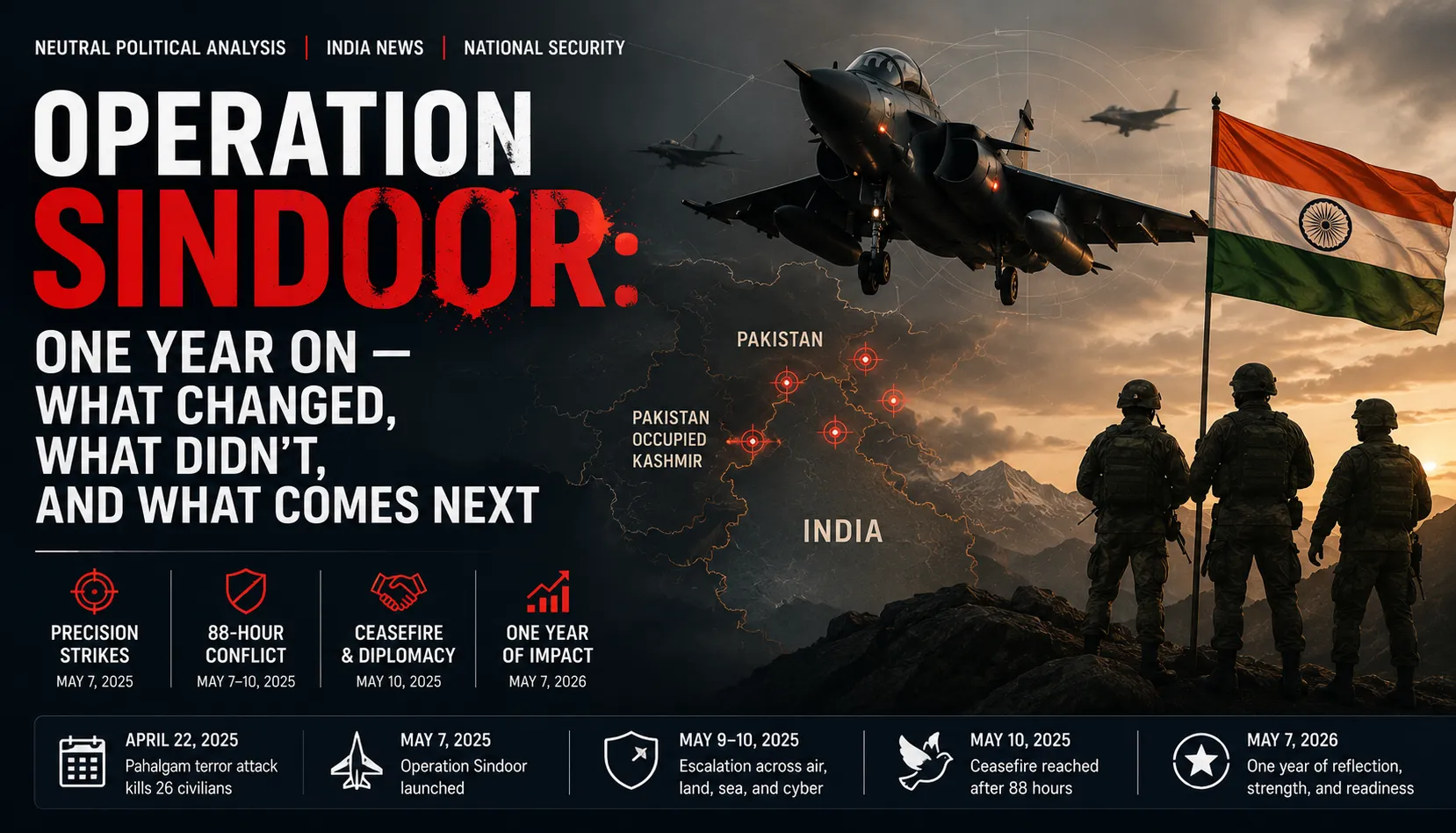
Between 1:05 and 1:27 am on May 7, 2025 — a 22-minute window — Indian armed forces conducted precision strikes on nine terror-linked sites across Pakistan and Pakistan-occupied Kashmir. The operation, named Sindoor, was India's military response to the Pahalgam terror attack of April 22, 2025, which killed 26 civilians, mostly Hindu tourists, in Jammu and Kashmir's Baisaran meadow.
A year later, India has marked the anniversary with tri-service commemorations, a military tribute video released by the Indian Army, and statements from the country's top defence leadership. The four-day conflict that followed the initial strikes — involving aerial combat, drone exchanges, naval manoeuvres, and a US-brokered ceasefire — is now being formally studied as one of the most significant military episodes between two nuclear-armed states in decades.
What has actually changed in the year since? This article separates the documented facts from the ongoing analysis — and distinguishes between the official commemoration and the harder strategic questions it has not fully answered.
What Happened: The Established Facts
[Fact] On April 22, 2025, a terrorist attack in Pahalgam, Jammu and Kashmir, killed 26 civilians. The Indian government attributed the attack to Pakistan-backed terror groups, specifically citing cross-border linkages.
[Fact] On May 7, 2025, India launched Operation Sindoor — precision airstrikes targeting nine sites identified as terror infrastructure in Pakistan and Pakistan-occupied Kashmir, including reported headquarters of Lashkar-e-Taiba and Jaish-e-Mohammed.
[Fact] Pakistan responded militarily the following day. Fighting intensified on May 9–10, during which India struck 11 Pakistani air bases including Nur Khan, Rafiqi, Murid, Sargodha, and Jacobabad. Pakistan's foreign ministry claimed civilian casualties; India rejected those claims, stating only terror infrastructure was targeted.
[Fact] The conflict lasted 88 hours — May 7 to May 10 — before a ceasefire was reached, with the United States and other international actors reported to have lobbied for de-escalation as fears of rapid escalation grew. According to former Director General of Military Operations Lieutenant General Rajiv Ghai, Pakistan formally requested India to halt operations once damage assessments became public.
[Fact] India's economic and diplomatic pressure measures during the conflict included suspension of the Indus Waters Treaty, cancellation of visas for Pakistani nationals in India, and a ban on Pakistani artists.
The Anniversary: What India's Commemoration Signals
India's marking of the one-year anniversary was deliberate in tone. The Indian Army released a commemorative video on May 7, 2026, opening with Prime Minister Narendra Modi's statement that India would 'identify, track, and eliminate terrorists and their backers.' Tri-service ceremonies were held at the National War Memorial, field commands, and frontline air bases.
The Chief of Defence Staff and three service chiefs attended commemorative events. Official statements from all three services emphasised that Operation Sindoor demonstrated deep-strike capability and that any future provocation would be met with calibrated force — what defence analysts describe as 'deterrence signalling' rather than simple commemoration.
[Analysis] The anniversary events were structured less as retrospective tribute and more as forward-facing deterrence communication. Emphasising demonstrated deep-strike capability in official statements — rather than, say, intelligence cooperation outcomes or diplomatic progress — suggests the primary intended audience for the messaging was not domestic, but regional. This is a recognisable feature of how nuclear-armed neighbours manage strategic communication after military escalation.
The China Question
One of the more significant developments in May 2026 was India's formal response to reports of Chinese involvement during the conflict. India's Ministry of External Affairs issued a sharp public rebuke after a Chinese official reportedly acknowledged that Beijing had provided on-site technical support to Pakistan during the May 2025 exchanges.
[Fact] India's MEA stated that 'countries that consider themselves responsible must reflect on how such actions impact their global standing,' calling the reported Chinese support 'backing of terror infrastructure.'
[Fact] Pakistan had incorporated Chinese J-10C fighters and new versions of the JF-17 — equipped with PL-15 missiles — before the conflict, alongside Chinese-supplied air defence systems and electronic warfare capabilities.
[Analysis] The public naming of China as a supporting actor — rather than a neutral bystander — in the India-Pakistan conflict marks a shift in how India frames the trilateral security dynamic between New Delhi, Islamabad, and Beijing. Whether this leads to substantive diplomatic or strategic recalibration with China, or remains rhetorical positioning, will be one of the more consequential threads to follow in the second year post-Sindoor. The Diplomat noted in its May 2026 analysis that the conflict has weakened external constraints on future escalation and compressed decision timelines — a particularly concerning dynamic given China's potential role as a force multiplier for Pakistan.
What Actually Changed: Military Modernisation
The most concrete changes in the year following Operation Sindoor have been in defence procurement, doctrine, and inter-service integration.
India
Rafale fighter acquisitions were accelerated. The conflict underscored the operational value of advanced air superiority platforms carrying SCALP cruise missiles and HAMMER precision-guided munitions.
BrahMos missile systems and indigenous drone technology — both used during the operation — have seen expanded procurement and development timelines brought forward under the Atmanirbhar Bharat defence initiative.
Tri-service operational integration, which was essential to the 22-minute Sindoor strike window, has been cited as a focus area for structural reform within the Indian military.
Air defence systems performed well against Pakistani incoming threats during the May 9–10 exchanges, exposing gaps in Pakistan's HQ-9 Chinese-supplied air defence network. India has continued investment in this layer of its defensive architecture.
Pakistan
Pakistan accelerated incorporation of Chinese J-10C fighters and new JF-17 variants. Medium and high-altitude UAV capabilities have also been expanded.
The 2025 conflict was the first instance of a nation striking the air bases of a nuclear-armed state — with India hitting 11 Pakistani air bases in three hours. This has prompted Pakistani military restructuring, details of which are not publicly confirmed.
What Analysts Are Watching: The Harder Questions
The official anniversary messaging from New Delhi is confident in tone. The independent strategic analysis is more cautious.
The Diplomat's May 2026 assessment identified four structural concerns that Operation Sindoor has not resolved and may have intensified:
Compressed timelines: The speed of India's decision to strike and Pakistan's counter-escalation suggests future crises will move faster than existing crisis management mechanisms can respond. The next incident may not allow for the same diplomatic runway that the US leveraged in May 2025.
Domestic pressure: In both countries, the political incentives now favour visible responses to provocations. Leaders who de-escalate quietly face harder domestic scrutiny than those who act publicly. This narrows the space for back-channel management.
Weaker external constraints: The US brokered the May 2025 ceasefire, but its appetite and capacity for sustained South Asia mediation has not grown. The structural conditions that make external intervention less reliable have not changed.
The perception that escalation is controllable: Sindoor ended without crossing the nuclear threshold. Both countries' militaries may have absorbed a lesson — accurate or not — that escalation between nuclear-armed states can be managed at the conventional level. This perception, if incorrect, is one of the more dangerous legacies of the 88-hour conflict.
[Analysis] These are not partisan observations — they come from defence and foreign policy analysts across the political spectrum in India and internationally. They sit in tension with the official commemoration narrative, which emphasises the success of the operation while saying less about what structural conditions have been addressed in the year since. Both things can be true simultaneously: the operation can have achieved its immediate military objectives while leaving the underlying strategic dynamics more fragile, not less.
What to Watch in the Months Ahead
CBI and intelligence findings on Pahalgam: The investigation into the April 22, 2025 attack and its cross-border linkages is ongoing. Its conclusions will shape both the domestic political narrative and the evidentiary basis for India's continued international briefings on Pakistan's role in the attack.
India's multi-party diplomatic offensive: The government has been sending multi-party parliamentary delegations to brief international partners on Pakistan's cross-border terror record. The reception of these delegations — and which countries engage substantively — will indicate whether Operation Sindoor improved or complicated India's diplomatic position.
Indus Waters Treaty status: The suspension announced during the conflict has not been formally resolved. Its status is a practical indicator of whether India-Pakistan relations are in genuine de-escalation or a managed freeze.
The next flashpoint: The Diplomat's analysis concludes that the structural conditions for another India-Pakistan crisis — compressed timelines, domestic pressure, weakened external constraints, and the normalisation of escalation — are more present, not less, than they were before May 2025. When and where the next trigger emerges matters less than whether the crisis management infrastructure has been strengthened in the intervening year.
The Bottom Line
Operation Sindoor marked a genuinely significant shift in India's counter-terrorism doctrine — from reactive restraint to anticipatory precision strike with stated red lines. The 88-hour conflict demonstrated deep-strike capability, accelerated military modernisation in both countries, and surfaced China's involvement as an open strategic variable rather than a background assumption.
The official anniversary message is one of resolve and deterrence. The independent strategic literature is one of caution about the structural dynamics that Sindoor has left in place — or reinforced. A balanced reading of the one-year mark holds both simultaneously: a significant military and doctrinal achievement, and an unresolved set of conditions that make the next crisis more, not less, difficult to manage.
This article will be updated as the CBI investigation concludes and as India's multi-party diplomatic briefings generate publicly reported responses from international partners.