A few years ago, the dream for most startup founders—especially in artificial intelligence—was simple.
Build something people can’t ignore.
Grow faster than anyone expects.
Raise money.
Get acquired by a tech giant.
Walk away with a life-changing exit.
That playbook created some of the biggest success stories in modern tech.
But in 2026, something changed.
And the story of Manus AI may be the clearest example yet of how the rules of global technology are being rewritten.
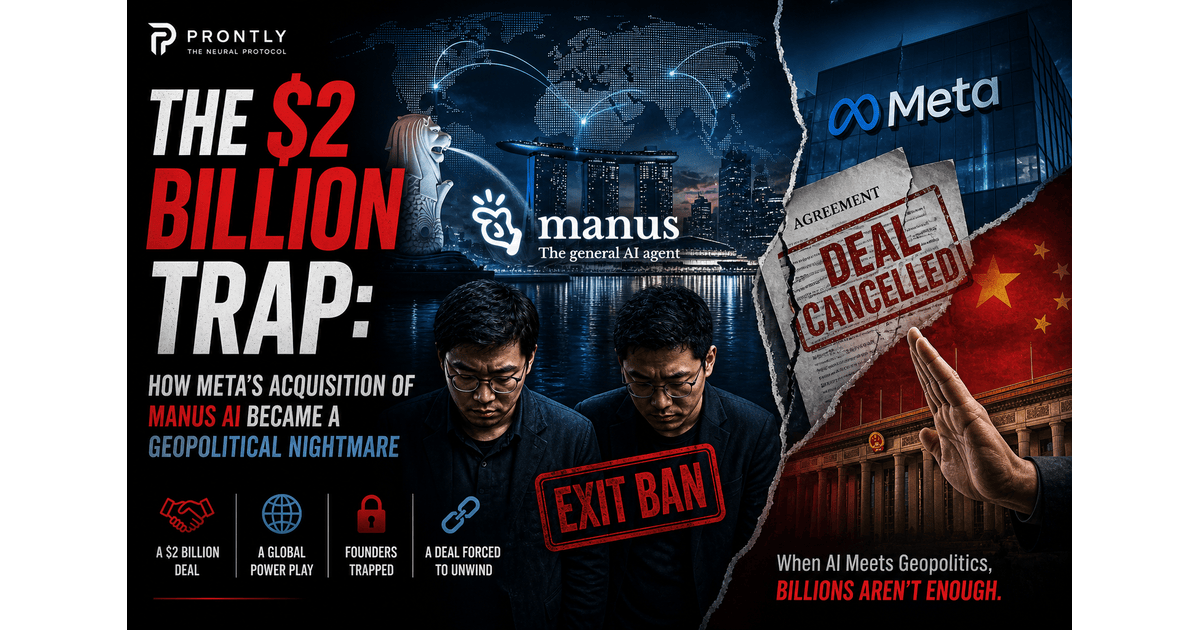
What looked like a dream acquisition—a reported $2 billion buyout by Meta—has now become one of the most controversial AI deals in recent history.
Founders reportedly unable to leave China.
Governments stepping in.
A completed acquisition being forced to unwind.
And Silicon Valley suddenly realizing that corporate paperwork may no longer be enough in the age of AI nationalism.
This isn’t just a startup story anymore.
It’s a story about power.
And it may define how global AI companies operate for the next decade.
How Manus AI Became One of the Hottest Startups in the World
When Manus AI launched, most people assumed it was just another AI company trying to ride the hype wave.
They were wrong.
Manus wasn’t built as a chatbot.
It was built as an AI agent platform—a system designed not just to answer questions, but to actually complete tasks.
Instead of simply generating text, Manus could:
Write and execute code
Connect with external APIs
Manage files
Run multi-step workflows
Complete business automation tasks
In simple terms:
Most AI tools talk.
Manus acted.
That difference mattered.
Very quickly, the startup started attracting serious attention across Asia, Europe, and the United States.
Reports suggest that by late 2025, Manus had reached roughly $100 million in annual recurring revenue, an extraordinary milestone for a company barely a year old. Multiple outlets also reported explosive user growth and strong enterprise adoption.
In the AI world, numbers like that create instant interest.
And soon, some of the biggest investors in the world started watching.
The Problem Nobody Could Ignore: Chinese Roots
There was just one issue.
Manus may have been growing like a global startup…
…but it was founded by Chinese entrepreneurs and originally built in China.
And in today’s geopolitical climate, that matters more than ever.
The United States has been tightening restrictions around investments involving Chinese frontier technologies—especially in areas like:
Artificial intelligence
Advanced chips
Robotics
Semiconductor infrastructure
For Manus, this created a major challenge.
If they wanted Western capital…
If they wanted access to Silicon Valley…
If they wanted a billion-dollar acquisition…
They needed a new strategy.
The Singapore Move
In mid-2025, Manus made a move that many people in Asian tech quietly understood.
The company shifted its operations to Singapore, moving key staff and restructuring its corporate identity. Multiple reports say its headquarters and core team were relocated there.
On paper, the company was no longer operating as a China-based startup.
To outside investors, this changed everything.
Singapore is viewed globally as stable, business-friendly, and politically neutral.
For many founders, it became the perfect launchpad for global expansion.
And for Manus, the strategy appeared to work.
Then Meta Came Knocking
By December 2025, Meta was aggressively expanding its AI ambitions.
The company already had social platforms used by billions:
Facebook
Instagram
WhatsApp
But Meta wanted something bigger:
AI agents.
Systems that could automate real business tasks, content workflows, customer operations, and internal tools.
Manus fit that vision almost perfectly.
So in December 2025, Meta announced it would acquire Manus in a deal reportedly worth between $2 billion and $3 billion.
For many founders, this would have been the ultimate ending.
But for Manus…
it was just the beginning of the nightmare.
Beijing Saw Something Very Different
From Silicon Valley’s perspective, this looked like a normal acquisition.
From Beijing’s perspective, it looked very different.
Chinese regulators reportedly viewed Manus not simply as a Singapore company—but as technology originally built by Chinese talent, rooted in Chinese research ecosystems, and now being transferred to an American giant. Reuters and other outlets reported that Chinese authorities viewed the deal through a national security lens.
And in modern AI politics…
that changes everything.
For China, AI is no longer just business.
It’s strategy.
It’s infrastructure.
It’s military relevance.
It’s national power.
And governments rarely let strategic assets leave quietly.
The Situation Escalates
In March 2026, reports emerged that Manus co-founders had been summoned to Beijing for regulatory review.
Soon after, reports indicated Chinese authorities barred key founders from leaving the country during the investigation.
Then came the bigger shock.
In April 2026, China’s National Development and Reform Commission ordered Meta to unwind the acquisition, according to Reuters, Business Insider, and other outlets.
That meant:
Reverse the deal
Restore ownership
Stop using the technology
Potentially separate teams already integrated into Meta systems
In global M&A history, this kind of reversal is extremely rare.
Especially after a deal has already been publicly announced and partially integrated.
Why This Changes Everything
This story isn’t just about Manus anymore.
It sends a message to every founder, investor, and tech executive in the AI world.
That message is simple:
In 2026, where your company is registered matters.
But where your technology was born may matter even more.
This creates massive uncertainty for:
Venture capital firms
Cross-border acquisitions
Global AI startups
Chinese founders operating overseas
For years, relocating to Singapore was seen as a practical way to access global capital.
Now, that path looks much riskier.
What Silicon Valley Is Learning
For companies like:
Meta
Google
Microsoft
this case creates a new question:
How do you acquire frontier AI technology without triggering geopolitical risk?
Because if billion-dollar deals can be reversed months later…
then every acquisition involving strategic AI becomes more complicated.
Much more complicated.
The Bigger Reality
The Manus story reveals something uncomfortable:
We are no longer living in a world where technology moves freely.
AI is becoming a geopolitical asset.
And nations are beginning to treat talent, models, infrastructure, and algorithms the same way they treat:
Energy resources
Semiconductor supply chains
Defense technology
The Manus acquisition didn’t fail because of bad business.
It failed because the world changed.
And the founders underestimated just how much it had changed.
Final Thought
For startup founders, the old dream used to be simple:
Build globally. Exit globally.
But in the AI era, that may no longer be enough.
Because now, building great technology isn’t the hardest part.
Navigating global power may be.
And the story of Manus AI could be remembered as the moment the world finally realized that AI companies aren’t just startups anymore—
They’re strategic assets.