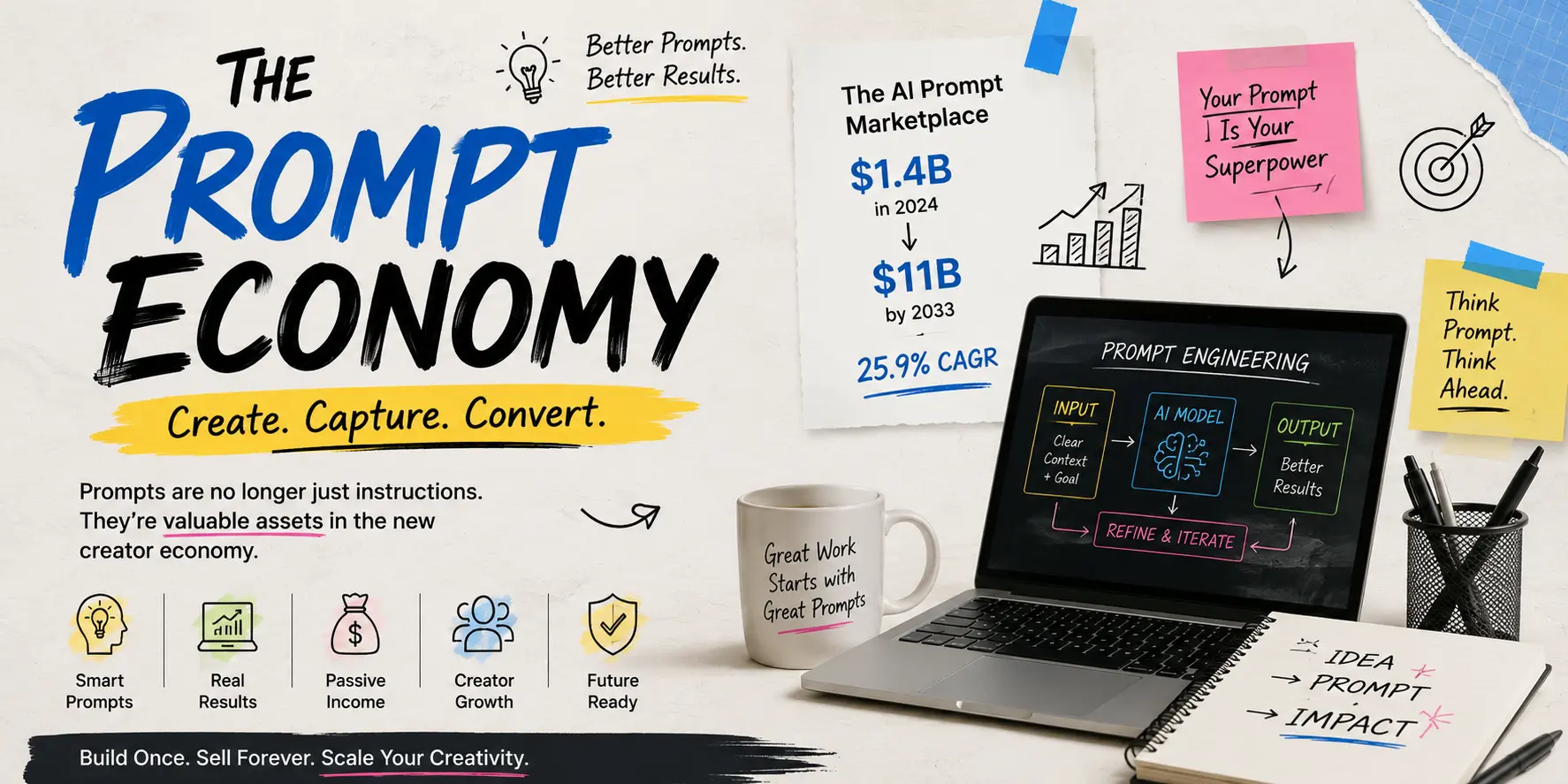
Here's a number that should stop you mid-scroll: the global AI prompt marketplace was worth $1.4 billion in 2024. By 2033, analysts project it will hit nearly $11 billion — a 25.9% compound annual growth rate. That's not a niche market anymore. That's an economy.
And yet, the majority of creators are still treating AI prompts like disposable Google searches — type it once, get an output, move on. They're leaving an enormous amount of value on the table.
What's happening right now isn't just a productivity shift. It's the emergence of a new creative asset class — one where the right prompt, engineered with craft and context, is worth real money. This piece unpacks what that means for creators, freelancers, and digital builders who want to stay ahead.
Prompts Are No Longer Just Instructions — They're Intellectual Property
A year ago, most professionals were still figuring out how to write a decent ChatGPT prompt. Today, prompt engineering has matured into something closer to a professional craft — one that PwC's latest AI Jobs Barometer says commands a 56% wage premium for skilled practitioners, up from 25% just twelve months prior.
The numbers from creators on the ground back this up. On platforms like PromptBase and Gumroad, top prompt engineers are pulling in $5,000 to $20,000 per month selling prompt templates alone — with zero inventory, no shipping, and near-zero marginal cost per sale.
The shift makes sense when you look at the broader market context. Over 83% of content creators now use AI regularly in their workflows, and AI is proven to boost overall productivity by up to 66%. When everyone has access to the same base models — GPT-5, Claude, Gemini — the differentiation lives entirely in how you talk to them. The prompt is the product.
Why Most Creators Still Get This Wrong
There's a trap that catches most people new to AI-assisted creation: they optimize for speed instead of craft. A quick, vague prompt gets a quick, mediocre output. Then they blame the model.
The reality is closer to what we see in any skilled trade: the tools are commoditized, but the expertise to use them well isn't. A carpenter and a hobbyist both have access to the same saw. What's different is the knowledge, the precision, the years of context loaded into every cut.
Prompts work the same way. The difference between a generic prompt and a high-value one often comes down to specificity of role, layered context, output formatting constraints, and iterative refinement — none of which most creators have been taught to think about systematically. Organizations implementing structured AI workflows are reporting 25–40% efficiency gains, while ad-hoc users still wonder why their results feel generic.
Real Creators, Real Results: How the Prompt Economy Works in Practice
Take the case of independent designers who've pivoted from selling Figma templates to selling AI image prompt packs for Midjourney and DALL-E. One category might sell for $15 per license, but the best prompt packs — curated, tested, and beautifully documented — command $79–$149 per bundle and sell to thousands of buyers without any active fulfillment.
Or consider the growing niche of marketing strategists selling prompt libraries specifically built for LinkedIn content, email sequences, or SEO-optimized blog writing. These aren't general-purpose tools — they're precise instruments, built for specific jobs, by people who understand both the craft of writing and the mechanics of AI output.
The formula isn't complicated: identify a workflow where quality matters, build a tested prompt (or system), package it with clear documentation and examples, and distribute it where your audience already looks. The creator economy, now projected to exceed $480 billion by 2027, is actively rewarding people who do this well.
Five Ways to Start Treating Your Prompts Like Assets
Whether you're a solo creator, a freelancer, or a small studio, these moves are worth making now:
Build a personal prompt library. Every time you write a prompt that generates a genuinely good output, save it. Version it. Document what worked and what you changed.
Specialize by use case, not by tool. A prompt system for product photography, brand copy, or UX writing is far more valuable than a generic "AI prompt pack." Depth beats breadth.
Study the outputs obsessively. The best prompt engineers treat AI outputs like raw material — not finished work. Notice what the model misses, overweights, or misinterprets, and build that context back into the prompt.
Package and price with confidence. If your prompts consistently produce results that would otherwise take someone hours to achieve, they're worth real money. Don't undercharge just because it's "just a prompt."
Stay plugged into trend cycles. The highest-value prompts right now are for AI image generation, long-form content structuring, and automation workflows. What's trending in AI capabilities will shape what's in demand in prompt marketplaces within 60–90 days.
The Next 18 Months: What's Coming in the Prompt Economy
As models become more capable and multimodal — handling text, images, audio, and code in a single workflow — prompt complexity will increase, and so will the gap between creators who've invested in this skill and those who haven't. We'll likely see prompt subscriptions replace one-time purchases, custom prompt audits become a standalone service category, and AI prompt certifications start to carry weight in hiring decisions. The window to build expertise here, before the market gets crowded, is open right now — but it won't stay that way.
The Prompt Is the New Portfolio
A decade ago, having a GitHub profile or a Behance portfolio was the signal that separated serious creators from casual ones. Before that, it was a well-designed website. The signal shifts with the tools of the era.
Right now, that signal is your ability to think in prompts — to translate creative intent into structured AI instructions that produce work worth sharing, selling, or building on. The creators who develop this fluency early will carry a durable advantage for years.
Platforms like Prontly are built precisely for this moment — as a curated library of tested, high-quality prompts for creators who'd rather start from a strong foundation than reinvent the wheel every time. Because in a world where everyone has AI, the question isn't whether you use it. It's how well.