Artificial intelligence has changed visual creation forever. What once required expensive cameras, complex editing, or years of design experience can now begin with a single prompt.
But here’s the reality:
Most people using AI image tools still get average results.
Why?
Because the quality of your output depends on the quality of your prompt.
At Prontly, we analyze high-performing prompt systems used by creators, designers, marketers, and digital artists to generate cinematic, high-converting visuals.
This guide breaks down exactly how to write AI image prompts that produce professional results in 2026.
What Is an AI Image Prompt?
An AI image prompt is a structured instruction that tells an image model what to create.
Platforms like OpenAI, Midjourney, and Stability AI interpret your prompt and transform it into visual output.
A simple prompt:
> “A woman standing in a garden.”
This may work—but it lacks precision.
A professional prompt gives the AI context, style, lighting, composition, and detail.
Example:
> “A cinematic portrait of an Indian woman standing in a flower garden, golden hour lighting, 85mm lens, soft shadows, ultra-detailed skin texture, editorial photography.”
Same subject. Completely different result.
Why Most AI Prompts Fail
Most beginners make one of these mistakes:
1. Prompts are too short
AI needs context.
Bad:
> “A cat.”
Better:
> “A fluffy white cat sitting near a rainy window, cinematic lighting, shallow depth of field.”
2. No visual direction
Without style keywords, the AI guesses.
Use direction like:
cinematic
editorial
realistic
anime
fashion photography
studio lighting
3. No composition instructions
Composition matters.
Examples:
close-up portrait
wide-angle shot
overhead view
symmetrical framing
The Prontly Prompt Formula
At Prontly, we often use this formula:
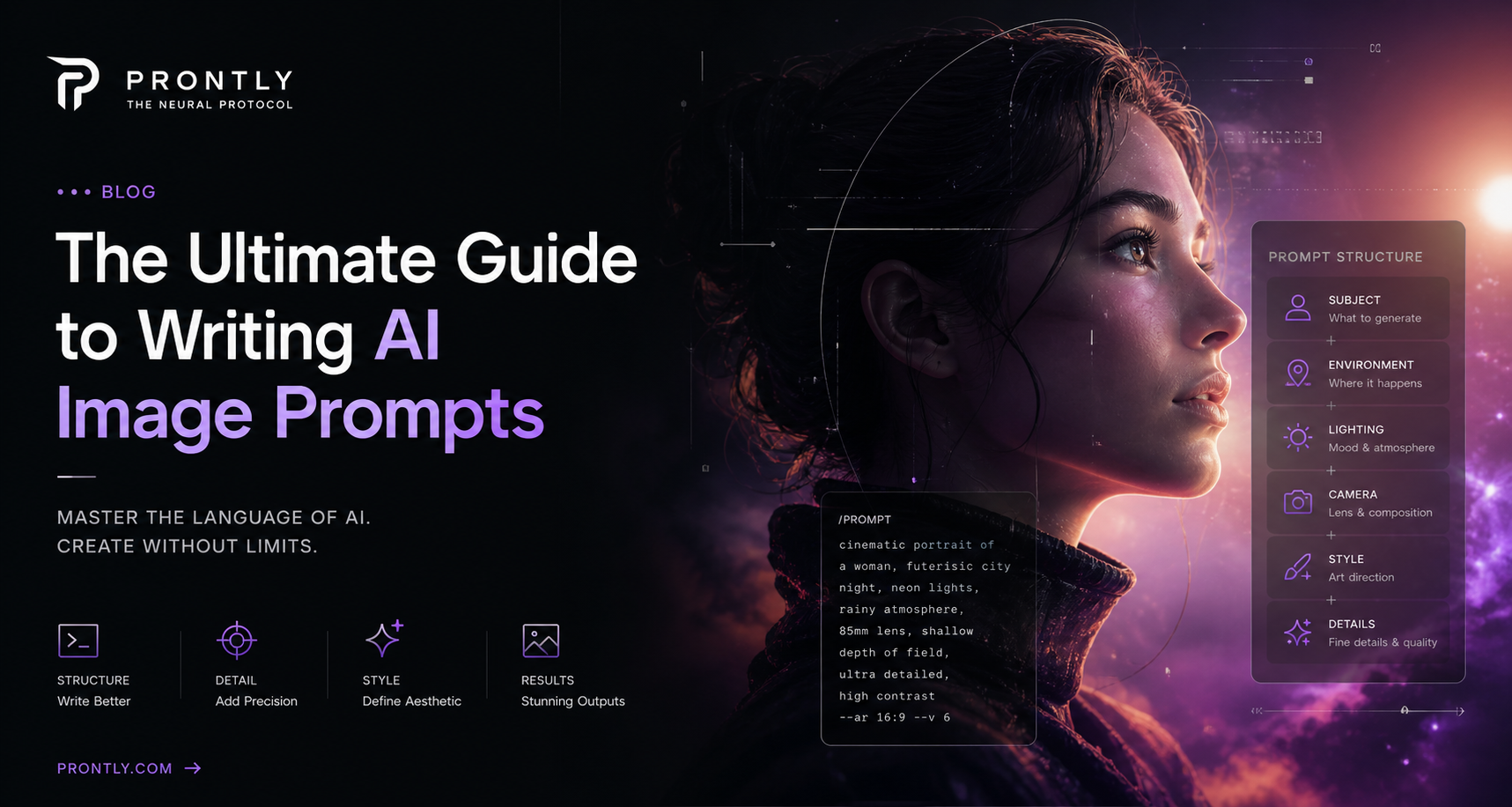
Subject + Environment + Lighting + Camera + Style + Detail
Example:
> “A luxury fashion model, standing in a futuristic neon street, blue cinematic lighting, 50mm lens, editorial photography, ultra-detailed, premium composition.”
This structure consistently creates stronger outputs.
Powerful Prompt Keywords
Lighting
Golden hour
Soft studio lighting
Neon glow
Volumetric light
Rim lighting
Camera
35mm lens
50mm lens
85mm portrait lens
Shallow depth of field
Style
Hyperrealistic
Cinematic
Editorial
Luxury branding
Minimalist
Advanced Technique: Negative Prompting
Negative prompts tell the AI what to avoid.
Examples:
blurry
low quality
extra fingers
distorted face
bad anatomy
This can significantly improve image quality.
Common Prompt Mistakes
Avoid:
Too many conflicting styles
Generic descriptions
Missing lighting details
No quality modifiers
Final Thoughts
AI doesn’t reward random prompts.
It rewards structure.
The creators getting the best results aren’t guessing—they’re engineering prompts.
That’s exactly what Prontly is built for.
If you want premium, production-grade prompts designed for creators, explore the Prontly prompt library and start creating visuals that stand out.