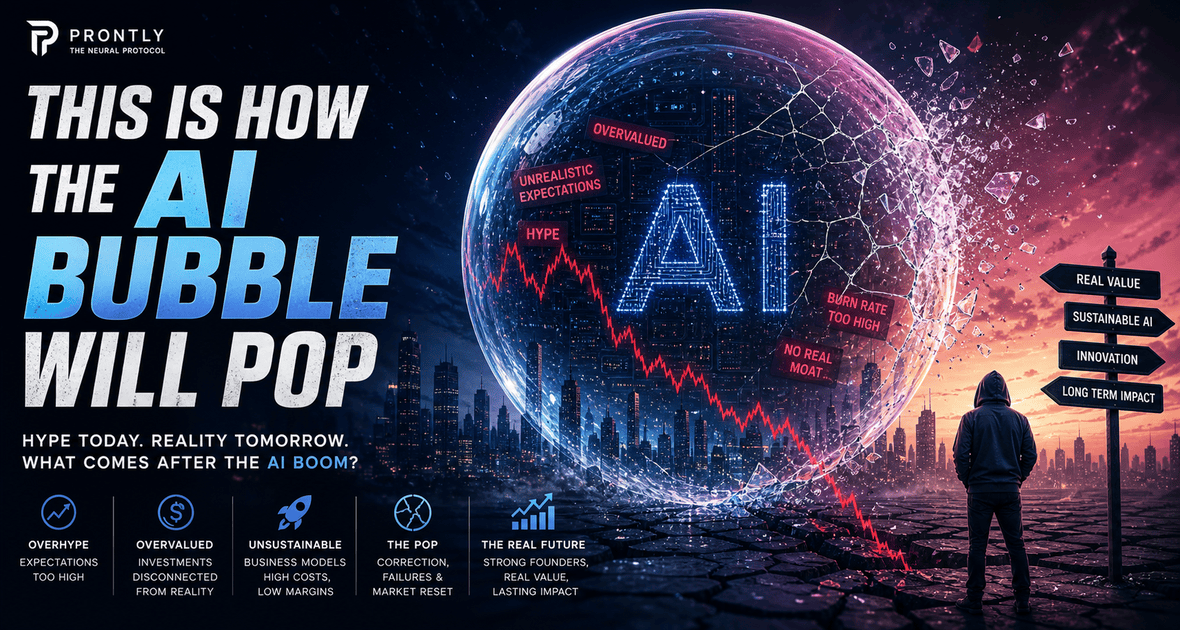
Artificial intelligence is everywhere right now.
It’s in startup pitches, investor decks, YouTube thumbnails, LinkedIn posts, college conversations, and billion-dollar earnings calls. Every week there seems to be a new “AI revolution,” a new model, a new company, or a new product claiming to change the future.
And to be fair, some of it is real.
AI has already transformed how people write, design, code, search, market, and create. Entire workflows that used to take hours can now be completed in minutes. Teams are becoming faster. Individuals are becoming more productive. New businesses are being built almost entirely on top of AI infrastructure.
So if AI is creating real value, why are so many people talking about an AI bubble?
Because history has a pattern.
Every major technological shift—whether it was railroads, electricity, the internet, smartphones, or crypto—went through the same cycle:
First comes innovation.
Then excitement.
Then money.
Then hype.
Then overvaluation.
Then unrealistic expectations.
And eventually, reality shows up.
That doesn’t mean the technology dies.
It means the bubble pops.
And if AI is following the same path, the real question isn’t if a correction comes.
It’s how.
Here’s what that could look like.
The First Sign: Too Many AI Companies With No Real Moat
Right now, one of the easiest ways to get attention in tech is to add “AI” to your product.
An image editor becomes an AI editor.
A note-taking app becomes an AI productivity system.
A chatbot becomes an AI assistant.
A basic SaaS tool becomes “AI-powered.”
In many cases, the product itself hasn’t fundamentally changed. The interface might be different. The marketing is stronger. The landing page looks futuristic.
But underneath, many of these companies are using the same APIs, the same models, and often solving the same problems.
This creates a dangerous situation.
When everyone is building on the same infrastructure, differentiation becomes weak.
If your product depends entirely on someone else’s model, and your only advantage is a nicer UI or better copywriting, you may not have a real business—you may just have a temporary distribution advantage.
And when customers realize five different tools give nearly the same result, price becomes the deciding factor.
That’s when margins collapse.
Some companies will survive.
Many won’t.
The Second Sign: Revenue Doesn’t Match Valuation
This is where bubbles become obvious.
In hype cycles, investors often pay for future potential, not current performance.
That’s normal—to a point.
But bubbles form when valuation becomes disconnected from reality.
Imagine a startup with:
No profit
Limited customer retention
Weak unit economics
High infrastructure costs
Heavy dependency on third-party models
And yet it’s valued like it’s the next trillion-dollar platform.
That works while optimism stays high.
But markets eventually ask harder questions:
How much does it cost to serve each user?
How long do customers stay?
Can the product defend itself?
Can the company scale without burning cash?
If the answers are weak, the valuation starts to crack.
And once investors stop believing the story, the correction happens fast.
Very fast.
The Third Sign: Users Stop Being Impressed
This may be one of the biggest triggers.
Right now, AI still has a novelty advantage.
People see:
AI-generated videos
AI-generated websites
AI-generated code
AI-generated voices
AI-generated art
And the reaction is often:
“Wow.”
But novelty doesn’t last forever.
Over time, users stop caring that something was made with AI.
They only care if it’s useful.
This is where many AI products will struggle.
Because a lot of current products are optimized for demos—not daily usage.
A product can go viral on social media and still fail in the real market.
Why?
Because real users don’t pay for “cool.”
They pay for:
Speed
Reliability
Accuracy
Workflow integration
Consistent results
If a product creates excitement but doesn’t create habit, users leave.
And when retention drops, the business becomes fragile.
The Infrastructure Problem Nobody Talks About
One of the hidden weaknesses in the AI boom is cost.
Training models is expensive.
Running models is expensive.
Serving millions of users is expensive.
Even companies with strong growth may be losing money every time users generate outputs.
That creates a dangerous growth illusion.
A company can appear successful because usage numbers look great.
Millions of prompts.
Millions of images.
Millions of users.
But if each interaction costs more than it earns, scale becomes a problem—not an advantage.
At some point, companies have to make hard choices:
Raise prices.
Reduce free access.
Limit features.
Introduce subscriptions.
Or cut infrastructure quality.
This often changes user behavior.
Growth slows.
Engagement drops.
Competitors become attractive.
And suddenly the business that looked unstoppable starts showing cracks.
Enterprise AI Could Trigger the Reality Check
Consumer hype gets attention.
Enterprise adoption decides who survives.
Right now, many AI startups assume that enterprise customers will eventually become their biggest revenue source.
But enterprise buyers are different.
They don’t care about hype.
They care about:
Security
Compliance
Reliability
Data ownership
Integration
Legal risk
A flashy AI demo might impress a founder.
It won’t automatically convince a large company.
Many AI startups will discover that enterprise sales cycles are slow, expensive, and difficult.
And if enterprise adoption happens slower than expected, revenue projections may collapse.
That’s often when investors begin pulling back.
The Open Source Pressure
Another reason the AI bubble may pop is open-source competition.
This is a massive force.
When powerful models become accessible to developers, companies lose pricing power.
Why pay a premium subscription if a similar capability can be self-hosted, customized, or integrated more cheaply?
Open source changes market dynamics.
It lowers barriers.
It increases competition.
It weakens proprietary advantage.
And it forces companies to compete on product experience—not just model access.
This is healthy for innovation.
But brutal for weak businesses.
Some AI startups may discover that their “core technology” isn’t actually defensible.
And when the market realizes that, valuations can collapse quickly.
Talent Inflation Will Come Down
Right now, AI talent is expensive.
Very expensive.
Engineers, researchers, prompt specialists, ML infrastructure experts—many are commanding extraordinary compensation.
That makes sense in an early boom.
But if funding tightens, hiring slows.
If hiring slows, compensation normalizes.
If compensation normalizes, market sentiment changes.
This may sound small, but it matters psychologically.
During bubbles, talent scarcity creates the feeling that the industry is unstoppable.
When hiring freezes begin, that perception changes.
People start asking different questions.
Not:
“How do I join AI?”
But:
“Which AI companies are actually sustainable?”
That shift changes everything.
Regulation Could Accelerate the Correction
Another major trigger could be regulation.
AI is moving faster than policy.
That creates risk.
Governments are already asking hard questions about:
Copyright
Deepfakes
Data usage
Privacy
Bias
Accountability
Automation impact
If regulation becomes stricter, many companies may need to rebuild products, change business models, or limit capabilities.
That creates friction.
And markets hate friction.
A few regulatory announcements can shift investor confidence faster than people expect.
But Here’s What Most People Get Wrong
When the AI bubble pops, AI itself won’t disappear.
That’s not how technological bubbles work.
When the internet bubble burst, the internet didn’t die.
Weak companies died.
Unsustainable business models died.
Overhyped valuations died.
But the underlying technology became stronger.
The same thing will happen with AI.
The bubble may pop.
The noise may fade.
Funding may slow.
Thousands of products may disappear.
But the companies solving real problems with real economics will become stronger than ever.
And those companies may define the next decade.
Who Will Survive?
When the hype fades, the winners will likely be companies that have:
1. Real Distribution
Products that people already use daily.
2. Strong Economics
Businesses that can scale profitably.
3. Workflow Integration
Products embedded into real behavior.
4. Brand Trust
Users who stay even when alternatives exist.
5. Technical Flexibility
The ability to adapt as models improve.
These companies won’t survive because they have “AI.”
They’ll survive because they built real businesses.
AI will simply be part of the engine.
The Real Bubble Isn’t AI—It’s Expectation
This may be the most important point.
The biggest bubble may not be in the technology.
It may be in human expectation.
People are expecting AI to:
Replace jobs instantly
Build billion-dollar companies overnight
Eliminate skill gaps
Create effortless wealth
Solve every business problem
That’s where disappointment begins.
Technology evolves faster than human systems.
Adoption takes time.
Trust takes time.
Behavior change takes time.
And markets often forget that.
So when expectations outrun reality, corrections happen.
That’s not failure.
That’s how markets reset.
And when they do, the noise disappears.
The builders remain.
That’s how the AI bubble will pop.
And that’s also how the real AI era will begin.