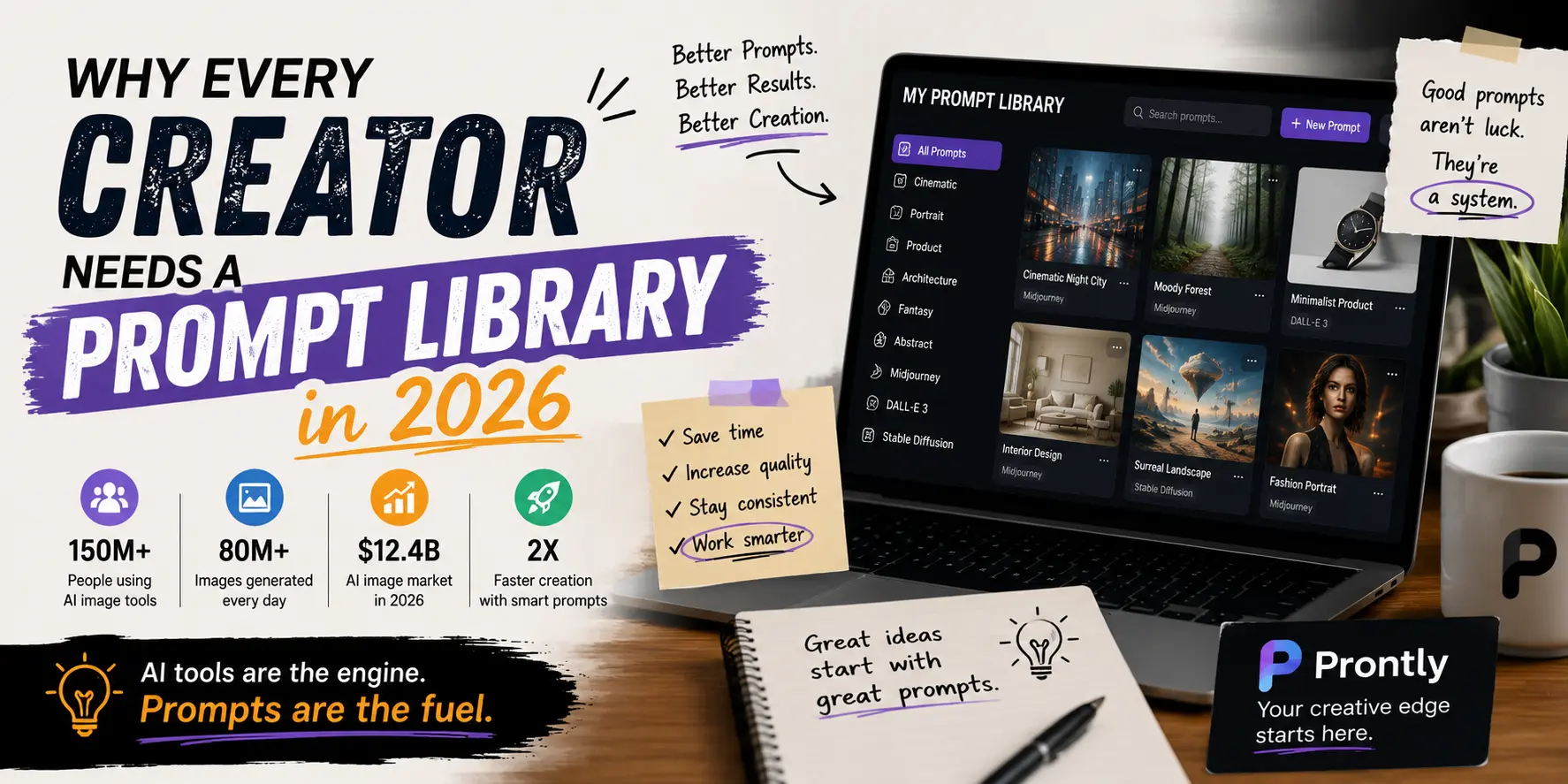
Imagine spending 45 minutes trying to coax an AI image tool into generating the exact cinematic, fog-drenched forest shot you have in your head — only to get something that looks like a screensaver from 2009. Now imagine opening a curated library, finding a prompt already tuned for that exact mood, and generating your image in under a minute. That gap is the difference between a creator who treats AI as a toy and one who treats it as a professional tool.
The AI image generation market hit $12.4 billion in 2026, with over 150 million people generating 80 million images every single day. The tools have matured. The real competitive edge now belongs to creators who know how to speak to them — and that starts with building, or accessing, a solid prompt library.
The Scale of What's Happening Right Now
The numbers behind AI image generation are staggering. Midjourney alone pulled in $500 million in revenue in 2025 — a 67% jump from the year before — with fewer than 40 employees and a user base approaching 20 million. Stable Diffusion, through its open-source architecture, powers approximately 80% of all AI-generated images on the internet. And according to a 2026 Adobe Creative Economy Report, 76% of professional graphic designers now use AI image generation tools as a regular part of their workflow.
This isn't a fringe movement. The creator economy itself is valued at $254 billion in 2025 and is projected to reach $2 trillion by 2035. The creators winning in that market aren't just producing more content — they're producing it faster, at higher quality, with more consistency. AI tools are the engine. Prompts are the fuel.
The Hidden Cost of Bad Prompts
Here is a number that should make any creator uncomfortable: research published in 2025 found that 78% of AI project failures stem not from the technology itself, but from poor human-to-AI communication. In plain terms, the AI is fine. The prompt is the problem.
For image generation specifically, a vague or poorly structured prompt does not just produce a mediocre image — it burns time, credits, and creative momentum. Companies that invest in systematic prompt engineering achieve up to 340% higher ROI on their AI usage compared to those relying on ad hoc, improvised inputs. Meanwhile, demand for prompt engineering roles in creative agencies has grown 1,200% year-over-year since 2023, according to LinkedIn's Economic Graph data. The industry has already decided this skill is valuable. Individual creators who figure that out early are going to have a serious structural advantage.
What a Real Prompt Library Looks Like in Practice
A fashion photographer who moved to AI-assisted concept generation described her workflow shift this way: for the first three months she generated prompts from scratch every session, burning 30 to 40 minutes per project just in iteration. After building a categorized library of reusable prompt templates — organized by lighting style, mood, model pose, and background environment — her generation time collapsed to under five minutes per concept board.
That's the practical case for prompt libraries. But the broader principle applies across every creative discipline using tools like Midjourney, DALL-E 3, or Stable Diffusion. Reusable prompt templates function like code functions: they're tested, versioned, and composable. The most sophisticated creators in 2026 treat their prompt collections the way developers treat code repositories — organized, searchable, and continuously improved.
Platforms like Prontly are built precisely for this moment: a searchable, curated AI prompt library where creators can find ready-to-use prompts for any visual style, use case, or tool — rather than starting from a blank cursor every time.
How to Build Your Prompt Practice
Whether you're starting from scratch or trying to systematize what you already do, these five steps will move the needle:
Start with categories, not single prompts. Organize by style (cinematic, editorial, minimalist), mood (moody, bright, surreal), and tool (Midjourney V7, DALL-E 3, SDXL). Categories scale; random prompt files don't.
Note what works and why. When a prompt lands perfectly, annotate it. Which modifiers made the difference? Understanding the mechanism makes it repeatable.
Use a reference library. Browsing a curated prompt library exposes you to structures and combinations you wouldn't think to try on your own. Treat it like a creative reference book, not a shortcut.
Build prompt templates with fill-in slots. A base structure like "[subject], [lighting style], [camera angle], [mood], [art style], 8K, highly detailed" gives you a reusable scaffold you adapt rather than rewrite.
Version your best prompts. Keep a running doc or note with your top performers. Iterate from what works, not from zero.
Where This Is Heading
The next 18 to 24 months will see prompt engineering move from a niche skill to a baseline creative competency — the equivalent of knowing how to use layers in Photoshop in 2005. AI models are already developing adaptive prompting capabilities that refine outputs based on prior context, and multimodal prompting (combining text, reference images, and style parameters simultaneously) is becoming standard in tools like Midjourney and Adobe Firefly.
The prediction worth banking on: by 2028, creators who cannot structure an effective AI prompt will be at the same disadvantage as those who couldn't use Google in 2001. The floor is rising fast.
The Takeaway
The tools that generate 80 million images a day are not going away. What separates a creator drowning in prompt iterations from one moving with precision is the same thing that separates a craftsperson with good tools from one who has mastered them. Building — or tapping into — a curated prompt library is one of the highest-leverage moves available to any visual creator right now.
Platforms like Prontly exist to give creators exactly that foundation: a library of battle-tested, production-ready prompts across every style and use case, free and always growing. The blank cursor is optional. The quality isn't.