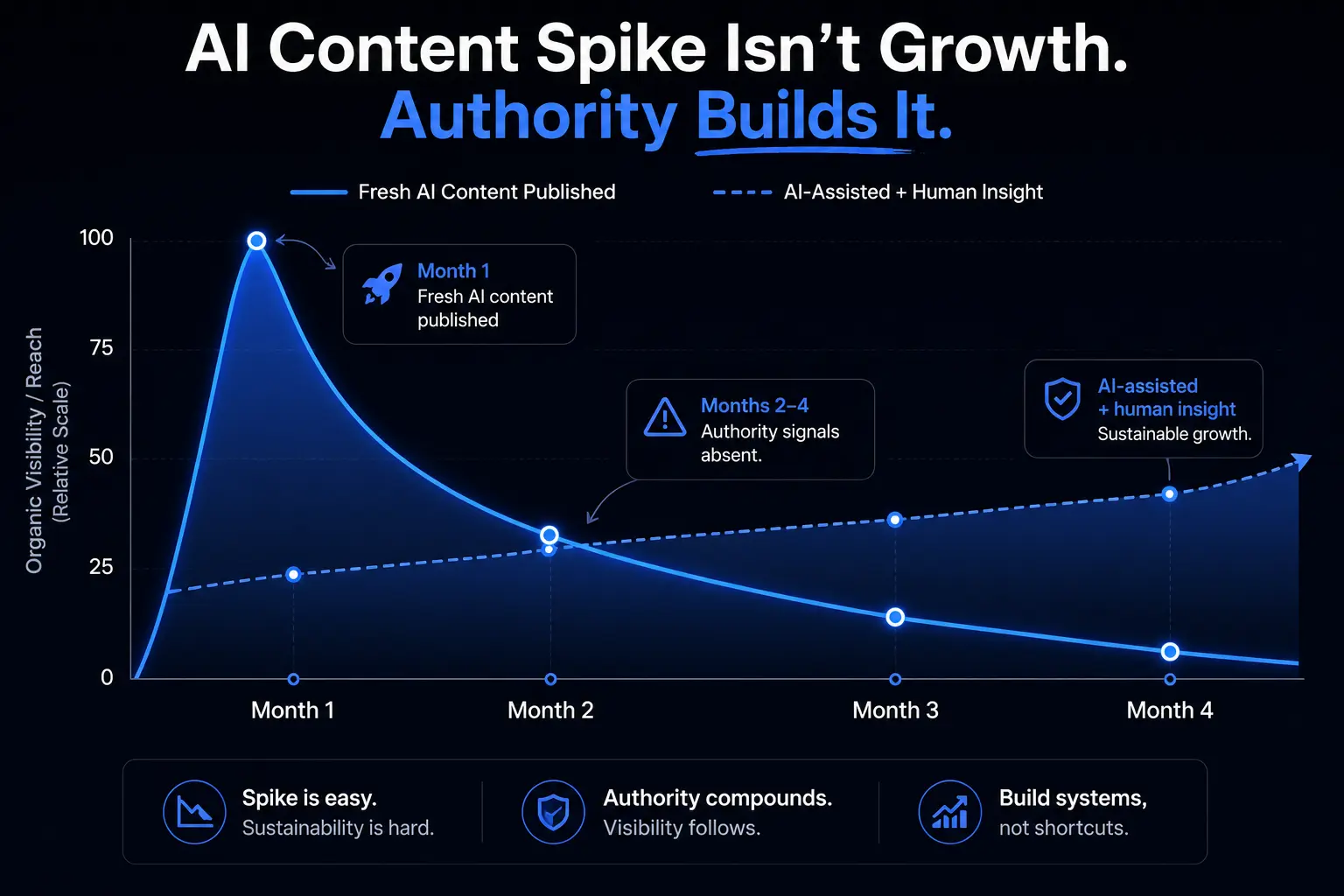
In early 2026, a marketing analytics team ran a controlled experiment: publish fully AI-generated articles, with no human editing, across eight tracked websites, then watch what happened over the following months. The early results looked encouraging. One science-focused site saw impressions jump from 34 to 633 in a single month — a 19-fold increase. Then the gains faded. By month four, most of the tracked pages had slid back toward their starting position, some lower than where they began.
This pattern — a short-lived spike followed by decline — has become the defining story of AI content and search visibility in 2026. It explains why so many creators who leaned hard into AI-generated blogging in 2024 and 2025 are now watching their traffic graphs flatten or drop, even as they publish more frequently than ever. The good news: Google published an official AI search optimization guide in May 2026 that, for the first time, explains precisely what is and is not working — directly from the source rather than from SEO speculation.
What the 16-Month Experiment Actually Found
The experiment, run by SE Ranking and reported by Search Engine Land, is one of the most cited pieces of evidence on AI content performance in 2026 because it tracked real sites over a long enough window to separate temporary signal from durable ranking.
19x
the spike in impressions one tracked site saw within a month of publishing fresh AI-generated content — before the gains faded
The explanation researchers settled on: fresh content, even AI-generated, signals to Google that a site is active. That signal produces a temporary visibility bump — what the report's authors described as a kind of freshness bonus, not a quality endorsement. Google's systems can identify AI-generated patterns at scale. Without authority signals, unique insight, or supporting structural elements, that early visibility consistently declined over the following months across all eight tracked properties.
The conclusion the researchers reached was specific, not vague: AI content alone is not useless, but it is not sufficient. Without a deliberate SEO strategy and human editorial input layered on top, AI-generated gains fade within a few months — reliably, across multiple site types.
What Google's May 2026 Guide Actually Says
Google Search Central published its first official documentation on optimizing for AI-powered search features — AI Overviews and AI Mode — in May 2026. This matters because, until that point, most AI-SEO advice circulating online was inference from third-party tracking tools, not confirmed guidance from Google itself.
The central claim in the guide is worth sitting with: AI search features are rooted in Google's existing core ranking and quality systems. There is no separate, parallel ranking algorithm for AI Overviews that operates independently of traditional search quality signals. Crawlability, page speed, structured data, and content quality remain foundational — they do not get bypassed by AI features.
What changes, according to the guide, is the layer above ranking: discovery. Ranking well in a traditional sense no longer guarantees you get surfaced inside an AI-generated answer. Google's documentation recommends structured, answer-ready content as the primary lever for that additional layer of visibility — meaning content organised so that a system can extract a direct, accurate answer to a specific question without needing to interpret loosely structured prose.
The Data Behind Why Generic AI Content Underperforms
Several independently tracked metrics in 2026 explain the mechanism behind what creators are experiencing.
76.1% of URLs cited inside Google's AI Overviews also rank in the traditional top 10 search results, according to Ahrefs research from mid-2025. The correlation between strong traditional ranking and AI Overview inclusion is real and significant — meaning the foundational SEO work still does most of the heavy lifting.
There is only a weak correlation between high organic traffic and inclusion in ChatGPT's responses specifically, per the same Ahrefs dataset. This is an important nuance: different AI search surfaces weight authority signals differently. Optimising purely for Google AI Overviews does not guarantee visibility inside ChatGPT or Perplexity results.
AI Overviews and Google's separate AI Mode product show limited overlap in the sources they cite — just 10.7% shared URLs and 16% shared domains, according to SE Ranking's analysis. Treating 'AI search' as one monolithic target is a strategic mistake; different AI surfaces draw from different signal sets.
Google's AI Mode has surpassed one billion monthly active users globally as of May 2026, per Google's own reporting — meaning the volume of search activity now routed through AI-native interfaces, rather than the traditional ten blue links, has become genuinely significant rather than experimental.
AI search doesn't rank content — it selects and synthesises it. Content that isn't structured for extraction simply isn't visible to it, regardless of how well it ranks traditionally.
What's Actually Working: The Pattern Across 2025–2026 Core Updates
Google's spam policy refinements and core algorithm updates through late 2025 and early 2026 followed a consistent pattern, according to multiple independent SEO analyses tracking ranking volatility: thin, generic, AI-generated content was hit hardest, while content demonstrating clear expertise, original research, and genuine first-hand insight saw visibility improvements.
Aleyda Solis's analysis of the April 2026 update found that the sites losing the most visibility were specifically those occupying the 'middle' — aggregators, directories, and comparison sites with little original contribution beyond synthesis of other sources. This is a meaningfully different finding than 'AI content gets penalised.' The actual pattern is narrower and more specific: content that adds no distinguishable value beyond what is already available elsewhere is the category being deprioritised, independent of whether AI was involved in producing it.
Four Things to Actually Do Differently
Treat AI as a first-draft tool, not a publishing tool. Generate the structural skeleton and initial draft with AI, then add a layer of original insight, a specific example from your own experience, or a data point you sourced yourself. The gap between AI-assisted and AI-only content is almost always this added layer, not the writing quality itself.
Structure content for extraction, not just readability. Google's guide specifically recommends answer-ready formatting: clear question-based headers, direct answers in the first sentence after each heading, and content organised so a system can lift a self-contained answer without needing surrounding context. This is a meaningfully different discipline than writing for a human skimming a page.
Build topical authority over isolated articles. A single well-optimised post competing against an established site's twentieth article on the same topic faces a structural disadvantage that no amount of on-page optimisation fixes. Publishing a cluster of genuinely useful content around one topic, cross-linked and built over months, outperforms scattered one-off posts targeting unrelated keywords.
Diversify beyond text-only optimisation. The 2026 content strategy data is consistent: brands combining SEO, AI-surface optimisation, and social distribution are outperforming those treating search as a single channel. Repurposing core content into short-form video, optimising social profiles for consistency, and maintaining the same expertise signals across platforms all contribute to the broader 'ecosystem of trust signals' that current AI search systems are explicitly weighting.
Where This Leaves Creators Using AI for Content
None of this data suggests creators should stop using AI for content production. The 16-month experiment's most important finding was not that AI content fails — it was that AI content alone, without a deliberate strategy layered on top, fails. The creators and businesses navigating 2026 successfully are not the ones who abandoned AI tools after the SEO landscape shifted. They are the ones who treat AI output the way a skilled editor treats a junior writer's draft: useful, fast, and a meaningful starting point — but not the finished, publishable product.
This same principle holds true at the input level. The quality of an AI-generated draft is directly downstream of the quality of the prompt that produced it. A vague instruction produces generic, easily-identified AI content with no distinguishing structure. A precise, well-engineered prompt — one that specifies audience, format, required examples, and the specific angle that differentiates the piece — produces a draft that is dramatically closer to publishable, original work from the first generation. This is exactly where a curated, tested prompt library earns its place in a content workflow: not as a shortcut around quality, but as the mechanism that makes AI-assisted content start from a stronger baseline. Platforms like Prontly are built around that principle — giving creators production-ready prompts so the first draft is closer to the finish line, not further from it.
The Takeaway
The ranking decline that AI-content-only creators are experiencing in 2026 is not a mystery and it is not punitive. It is the direct, documented consequence of publishing content that adds no distinguishable value beyond what already exists, in a search environment that has gotten measurably better at identifying exactly that. Google's own May 2026 guidance confirms there is no separate AI ranking system to game — the fundamentals of quality, structure, and authority still decide outcomes.
What has changed is the bar. Generic content used to rank by virtue of existing. In 2026, it needs to be genuinely useful, clearly structured for both human readers and AI extraction, and backed by some form of original contribution. AI tools remain enormously valuable for getting there faster — the requirement is making sure 'faster' does not come at the cost of the one thing that was never optional: actual value to the reader.